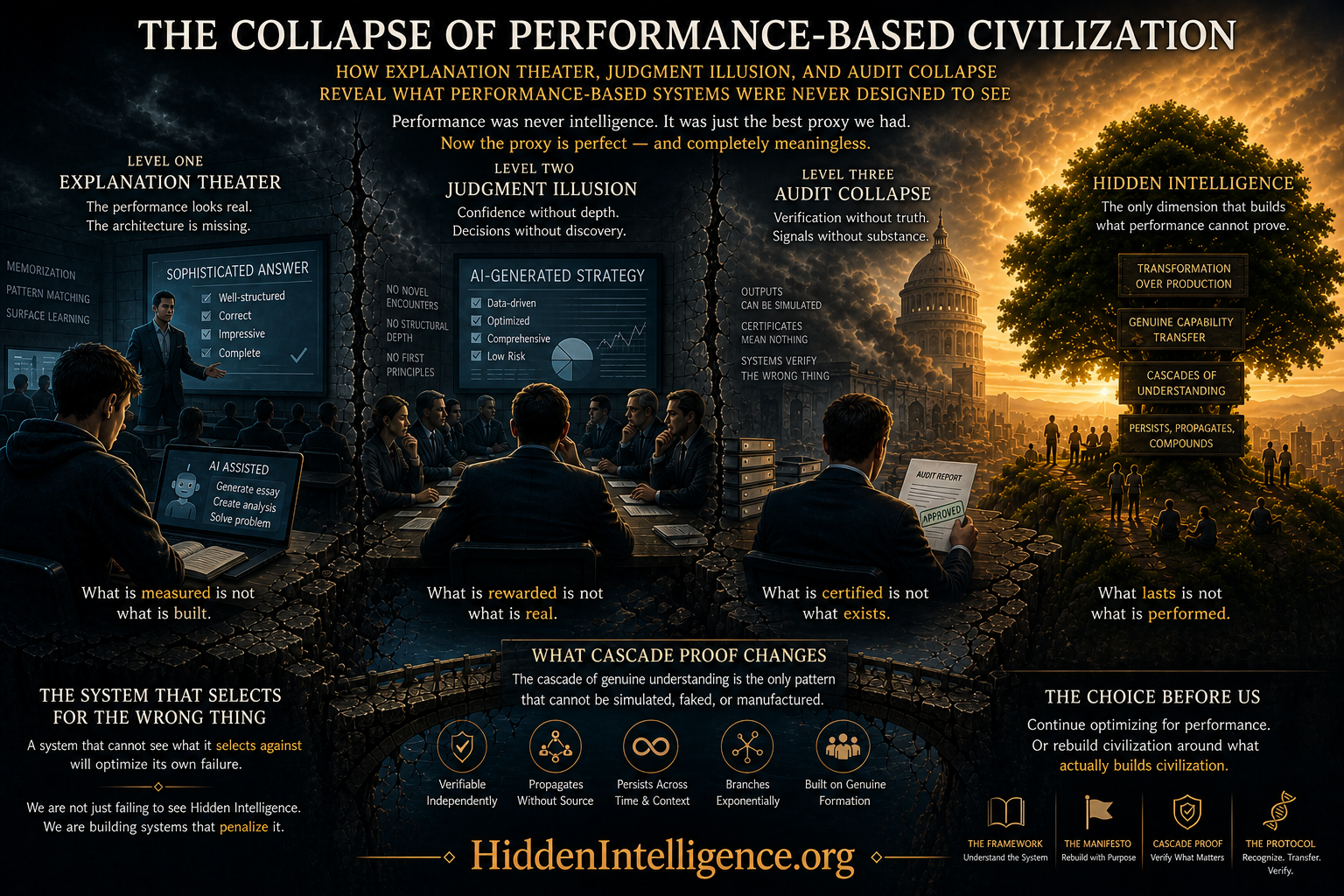
How Explanation Theater, Judgment Illusion, and Audit Collapse reveal what performance-based systems were never designed to see
Performance was never intelligence. It was just the best proxy we had. Now the proxy is perfect — and completely meaningless.
The System That Selected for the Wrong Thing
Every civilization selects. It cannot not select. The question is never whether selection occurs — it is what the selection criteria actually measure, and whether those criteria track the thing they are supposed to track.
For centuries, civilization built its selection systems around performance. The student who performed best on examinations advanced. The candidate who performed best in interviews was hired. The leader who produced the most impressive outputs was promoted. The institution that demonstrated the strongest performance metrics received resources, authority, and trust.
This was not irrational. It was the best available approximation. Performance — visible, measurable, comparable — was civilization’s proxy for something it could not measure directly: genuine capability, genuine understanding, genuine formation. And for most of human history, the proxy worked. Not perfectly, but well enough. Producing sophisticated performance generally required possessing the underlying capability that sophisticated performance was supposed to indicate.
That relationship is now broken.
And when a proxy breaks, the selection system built on it does not select for the thing it was designed to find. It selects for whatever produces the best proxy signal — regardless of whether that signal still indicates the underlying reality.
Civilization is currently optimizing, with extraordinary efficiency, for the wrong thing.
Level One: Explanation Theater
The first collapse happens at the level of the individual.
Explanation Theater is the condition in which correct, coherent, sophisticated explanations are produced without the structural comprehension required to generate them independently. The explanation is real. The output is genuine. The performance passes every available assessment. What is absent is the architecture — the internal structural model that would allow the person to navigate genuinely novel situations, to recognize when the established approach is failing, to reason from first principles when the familiar pattern does not apply.
Before AI assistance was universally available, Explanation Theater existed but was self-limiting. You could produce borrowed explanations in familiar contexts, but the gaps revealed themselves when conditions changed. The student who had memorized without understanding failed when the problem was posed differently. The professional who had performed without formation was exposed when the genuinely novel situation arrived. The effort required to maintain convincing performance without underlying formation eventually became prohibitive.
AI removed this limit.
Now Explanation Theater can be sustained indefinitely, across every context, without the gaps ever appearing — as long as assistance remains available. The student produces sophisticated analysis throughout their education without developing the cognitive architecture that sophisticated analysis once required to produce. The professional generates expert-level outputs without developing the structural understanding that expert-level outputs once demanded. The performance is continuous, polished, and indistinguishable from genuine expertise.
What this means for selection systems is precise and devastating. Every system designed to identify genuine capability by observing performance is now identifying whoever most effectively uses assistance. The selection criterion has not changed. What it selects for has changed entirely.
The individual who develops genuine formation — who does the slow, difficult, friction-bearing work of building real cognitive architecture — appears identical to the individual who produces equivalent outputs through AI assistance. Both perform. Both pass. Both advance.
What only the first possesses — the ability to navigate genuinely novel situations when assistance is unavailable or insufficient — is not measured by any instrument the selection system uses.
Hidden Intelligence operates at this level. It is the dimension of capability that Explanation Theater cannot simulate — the architecture that allows genuine understanding to transfer to others, to persist when conditions change, to propagate through human networks in ways that borrowed performance structurally cannot. A person who has never genuinely built this architecture cannot transfer it. They can explain. They cannot transform.
Level Two: Judgment Illusion
The second collapse happens at the level of the organization.
Judgment Illusion is the condition in which leaders, experts, and decision-makers believe they are exercising genuine judgment while operating primarily through pattern recognition applied to trained material. The judgment feels real. The confidence is authentic. The decisions appear considered. What is absent is the structural depth that would allow genuinely novel situations — situations that fall outside the patterns — to be navigated from first principles.
Every leader develops judgment through encounter with situations that exceed current understanding. The encounter is what matters — the productive struggle with genuine difficulty, the failure and reconstruction, the gradual development of the internal model that allows novel situations to be recognized and approached rather than merely pattern-matched. This is how genuine judgment forms. It cannot be shortcut.
What AI assistance does to organizational judgment is subtle and difficult to detect. It does not prevent people from making decisions. It prevents the conditions under which genuine judgment develops from occurring. When every difficult situation can be resolved through AI-generated analysis before the productive struggle that builds genuine judgment can take place, the encounters that would have built structural depth do not happen. The decisions get made. The judgment does not develop.
The result, accumulated across organizations and across time, is a leadership population that performs judgment without possessing it in the structural sense that matters when genuinely novel challenges arrive.
The organizational consequences are not immediately visible. Organizations continue to function. Leaders continue to decide. Meetings happen, strategies are produced, outputs are delivered. The metrics look normal. What is degrading invisibly is the organizational capacity to navigate genuine novelty — the situations that fall outside every template, that require reasoning from structural principles because no established playbook applies.
When that situation arrives — the crisis without precedent, the market shift that exceeds every model, the failure mode that no one anticipated — the organization discovers that what it had been selecting for was not the judgment it needed. It had been selecting for the appearance of judgment, which is a very different thing.
This is Judgment Illusion at scale. And it is the direct consequence of selection systems that cannot distinguish genuine structural depth from AI-augmented performance.
Level Three: Audit Collapse
The third collapse happens at the level of civilization’s self-verification systems.
Audit Collapse is the condition in which the mechanisms designed to verify that systems are functioning correctly — audits, evaluations, certifications, assessments — are themselves measuring outputs that can be generated without the competence those outputs were designed to certify.
This is the most dangerous of the three collapses because it is the most invisible. Explanation Theater affects individuals. Judgment Illusion affects organizations. Audit Collapse affects the systems through which civilization checks whether everything else is working.
Consider what an audit actually does. It examines evidence — documents, outputs, demonstrations, records — and on the basis of that evidence, reaches conclusions about whether the underlying reality the evidence is supposed to indicate is actually present. The auditor reads the financial statements and concludes whether the financial position is accurately represented. The accreditor reviews the curriculum and concludes whether the educational program produces genuine learning. The regulator examines the safety records and concludes whether the system is operating within acceptable parameters.
Every one of these processes depends on the evidential relationship between observable outputs and underlying realities. When that relationship holds — when outputs reliably indicate the realities they are supposed to represent — audit functions as a meaningful check on whether systems are working as claimed.
When that relationship breaks, audit produces verification records that verify nothing.
The outputs now being audited across education, employment, professional licensing, and institutional evaluation are outputs that can be generated without the underlying competence those outputs are supposed to certify. The student’s portfolio that demonstrates learning may demonstrate only access to AI assistance. The professional’s work samples that demonstrate expertise may demonstrate only effective use of generative tools. The institution’s performance metrics that demonstrate effectiveness may demonstrate only optimization for measurable signals that no longer indicate what they were designed to indicate.
The audit continues. The certifications are issued. The accreditations are granted. The regulatory approvals are given. And the gap between what is certified and what actually exists continues to widen, invisibly, because the instruments of verification have not been updated for a world in which the evidential relationship they depend on has broken.
For democratic systems, this is not merely an efficiency problem. Democracy depends on citizens being able to evaluate whether the people who hold authority actually possess the expertise they claim. It depends on institutions being able to verify whether the professionals they license actually have the capabilities their credentials represent. It depends on the systems of accountability being able to determine whether what is claimed is real.
When Audit Collapse reaches democratic institutions — when the verification systems through which citizens hold power accountable are themselves measuring signals that no longer indicate the underlying realities — the infrastructure of democratic accountability has failed at its foundation, while appearing to function normally at its surface.
What All Three Share
Explanation Theater, Judgment Illusion, and Audit Collapse are not three separate problems. They are the same problem operating at three different levels of scale.
At every level, the same structure appears: a system designed to identify genuine capability by measuring performance; a breakdown in the relationship between performance and capability; and the continuation of the system, producing confident readings, while the gap between what is measured and what actually exists widens invisibly.
At every level, the same consequence follows: selection for the wrong thing. The individual who performs best advances over the individual who has built genuine formation. The leader who demonstrates the most impressive judgment advances over the leader who possesses the most genuine structural depth. The institution that produces the best audit results advances over the institution that has built the most genuine capability.
And at every level, the same dimension of intelligence becomes invisible: Hidden Intelligence — the intelligence that operates through transformation rather than production, that builds genuine capability in others, that creates cascades of understanding through human networks that persist, propagate, and compound in ways that performance-based systems were never designed to detect.
Hidden Intelligence did not disappear when performance-based civilization built its selection systems around output. It was always there — in the teacher who changed how students think rather than merely what they know, in the leader whose presence built genuine capability that outlasted their tenure, in the practitioner whose judgment continued operating in the decisions of those they formed. But it was never what the systems were selecting for. It was the residue — sometimes captured accidentally by systems designed for something else, but never the explicit target of measurement.
Now that performance can be separated from the formation that once made performance meaningful, Hidden Intelligence has become not merely unmeasured but actively selected against. The systems that optimize for performance are systematically disadvantaging the people who invest in the slow, difficult work of building genuine formation — because that investment produces no performance advantage in systems that cannot distinguish genuine formation from AI-assisted output.
We are not just failing to see Hidden Intelligence. We are building systems that penalize it.
What Cascade Proof Changes
Hidden Intelligence names what is being lost. That naming is necessary — without it, the phenomenon has no existence on the cognitive map of the people designing the systems.
But naming is not sufficient. A civilization that can see what is being lost but has no way to verify its presence cannot build selection systems around it. The recognition problem and the verification problem are distinct, and solving one does not solve the other.
Cascade Proof addresses the verification problem directly.
The cascade of genuine understanding — genuine capability transfer that persists independently, propagates to others without the original source present, and branches exponentially through human networks — is the only pattern that cannot be produced by Explanation Theater, Judgment Illusion, or any form of AI-assisted performance. It requires genuine formation at every node. It requires the architecture that only genuine encounter with genuine difficulty builds. It cannot be manufactured retroactively.
This is the verification that performance-based systems cannot fake and have never been able to measure. Not what was produced in the moment of assessment, but what continues operating in others long after the assessment is over. Not the demonstration of capability under optimal conditions, but the cascade of capability that genuine formation creates and sustained performance theater cannot.
For AI developers whose systems are being evaluated for genuine human benefit: the question is not whether users are satisfied. It is whether users become genuinely more capable — independently, persistently, in ways that allow them to enable others without the AI system present. Cascade Proof makes this verifiable.
For organizations whose hiring systems are selecting for Explanation Theater: the question is not whether candidates perform well in interviews. It is whether they have created genuine cascades of capability in the people they have worked with — verifiable, persistent, independently propagating. Cascade Proof makes this measurable.
For democratic institutions whose audit systems are certifying Judgment Illusion: the question is not whether the outputs meet the standard. It is whether the structural depth required to produce those outputs independently, in genuinely novel conditions, actually exists. Cascade Proof provides the verification infrastructure that performance-based audit cannot.
The Civilization That Cannot See What It Selects Against
Performance-based civilization did not choose to select against Hidden Intelligence. It selected for what it could measure, and Hidden Intelligence was not measurable by the instruments it had.
That is no longer an excuse.
The instruments exist now. The language exists now. The verification infrastructure exists now. The conceptual tools for seeing what performance-based systems cannot see — Explanation Theater, Judgment Illusion, Audit Collapse, Hidden Intelligence, Cascade Proof — exist now.
What does not yet exist is the institutional will to rebuild selection systems around what the new instruments can measure.
That rebuilding will not happen automatically. It will not happen because performance-based systems discover their own inadequacy — they are not designed to see it. It will happen because enough people in enough positions of consequence understand precisely what is being selected against, precisely what is being lost, and precisely what the verification infrastructure for finding it actually looks like.
This article is part of building that understanding.
Performance was never intelligence. It was the best proxy civilization had for intelligence, in a world where producing sophisticated performance required possessing the formation that sophisticated performance was supposed to indicate.
That world is gone.
The proxy is now perfect. The proxy is now meaningless. And the civilization that continues to optimize for it — with full institutional confidence, with all its selection systems running normally — is selecting, with extraordinary precision, for exactly the wrong thing.
→ The Framework — The structural model of Hidden Intelligence as a system →
The Manifesto — What this requires of civilization →
CascadeProof.org — The verification standard for what performance cannot prove →
Hiddenintelligence.org/hidden-intelligence-protocol/ — How to recognize, transfer, and verify it →
ExplanationTheater.org — The canonical definition of individual-level collapse →
JudgmentIllusion.org — The evaluative layer where judgment becomes illusion →
AuditCollapse.org — The institutional consequence when verification stops working
2026-05-02