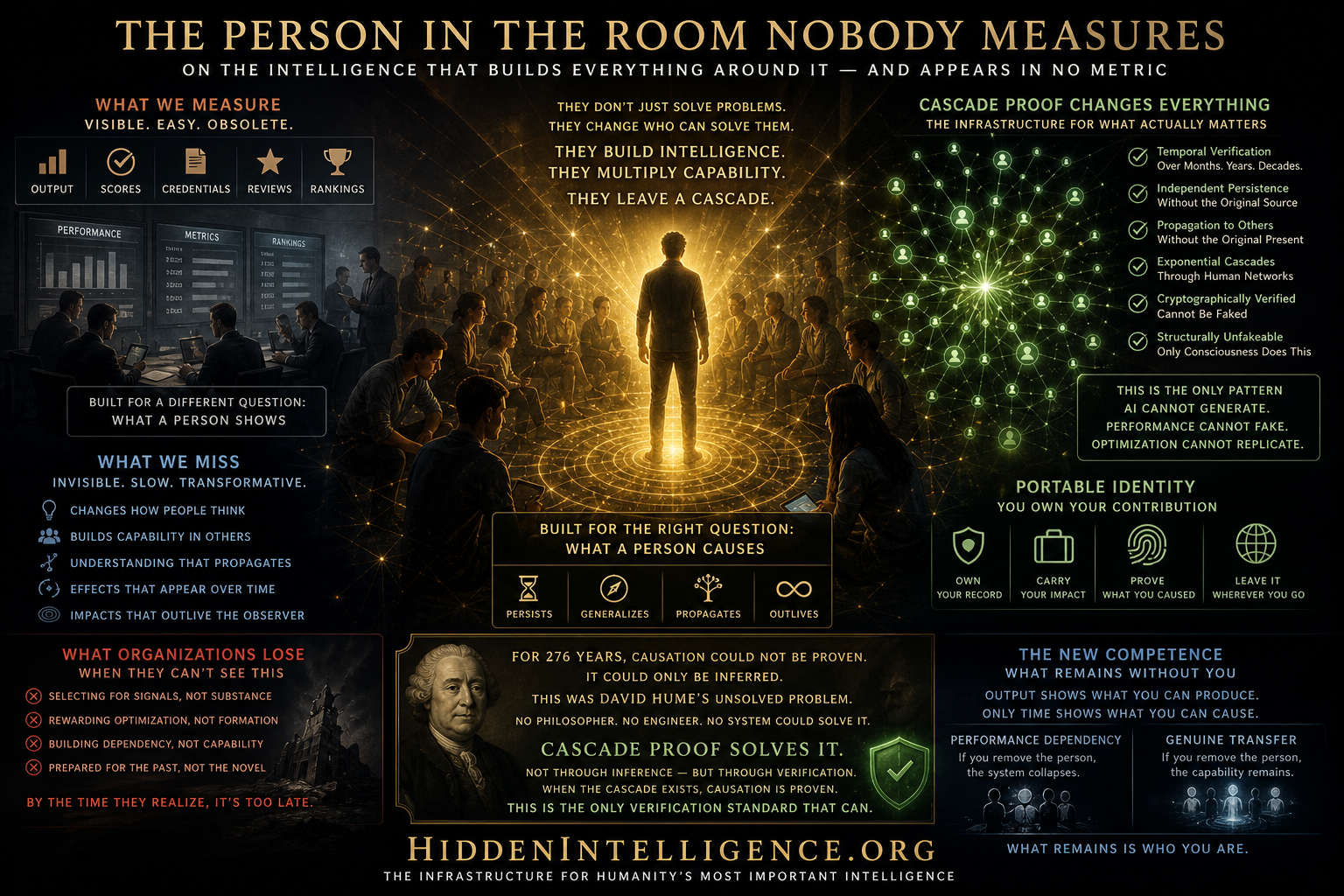
On the intelligence that builds everything around it — and appears in no metric
You have worked with this person. You may not have known what to call them. But you remember what happened after.
The Person You Already Know
There is someone you have worked with — in a team, in a classroom, in an organization — whose presence changed how everyone around them thought. Not through authority. Not through impressive output. Not through the kind of visible performance that gets noticed, recorded, and rewarded.
Through something harder to name.
After working with them, you found yourself thinking differently about problems you had seen before. Colleagues who had been stuck began moving. People who had lacked confidence in their own judgment began trusting it. The team’s conversations changed — became more precise, more honest, more capable of navigating difficulty. And the person at the center of this change was rarely the one presenting the most impressive slides or producing the most visible output.
They were the person in the room nobody measures.
And if you look closely, you will notice something even more unsettling.
These people rarely advance at the same speed as others. Not because they lack ability. Not because they lack ambition. But because what they do does not convert into the signals the system is built to recognize.
They leave behind more capable people — but no measurable trace of having done so. They increase the intelligence of the room — but their own position in the system does not reflect it.
And over time, something predictable happens. They either adapt to the system and start producing visible signals instead of invisible transformation — or they remain who they are, and accept that the system will never fully see them.
This is not a talent problem. It is a visibility problem built into the structure of how we measure value.
The most valuable person in the room is often the one your system is structurally designed to ignore.
You know who they are. You have probably worked with more than one. And if you think about the organizations, teams, and institutions that shaped you most, the person who actually changed how you think is almost certainly not the person who scored highest on any available metric.
This gap — between who gets measured and who actually matters — is not accidental. It is structural. And in the age of AI, it has become the most consequential structural failure in how civilization allocates its most important resource.
What We Measure — And What We Miss
Every organization that evaluates people is measuring something. The question is whether what it measures tracks the thing that actually matters.
What most systems measure: output volume, performance scores, credentials, years of experience, client ratings, revenue generated, projects completed. These are the visible traces of activity — the signals that can be captured, recorded, compared, and ranked.
What most systems miss: whether the people around you became more capable because of genuine encounter with your understanding.
Systems are not failing. They are functioning perfectly — at measuring the wrong thing.
This is not a subtle distinction. It is the difference between measuring what a person produces and measuring what a person causes. And these are not the same thing.
The person who produces the most impressive output may be doing so through AI assistance that leaves no lasting capability in anyone around them. The person who generates the most visible activity may be creating dependency rather than formation — surrounding themselves with people who need them rather than people who have been genuinely developed by them.
Meanwhile, the person whose presence quietly restructures how a team thinks — whose questions reveal assumptions no one had noticed, whose way of approaching problems becomes the team’s way of approaching problems, whose understanding propagates independently through the people who encountered it — registers on none of the metrics.
Not because the metrics are poorly designed. Because they were designed for a different question.
The metrics were designed to measure what a person shows. They were never designed to measure what a person causes.
This would be a tolerable problem — if the signals we measure were merely incomplete. They are not. They are now actively misleading.
Because in the presence of AI, the signals we use to identify capability have detached not just from reality — but from necessity. You can now produce what used to require understanding without having that understanding. You can demonstrate what used to prove experience without having lived it. You can perform what used to signal judgment without having built it.
Which means something deeply counterintuitive has become true: the more a system relies on visible performance signals, the more exposed it becomes to selecting people who optimized for appearing capable rather than becoming capable.
The highest performer is not always the most valuable contributor — and increasingly, they are not even correlated.
The error is not coming. The error is compounding.
Why This Person Is Invisible to Every System
Understanding why the person in the room nobody measures is invisible requires understanding what measurement systems are actually built to detect.
Every performance system, every credentialing mechanism, every hiring process, every annual review is built around observable signals — things that can be recorded at the moment of assessment and compared across individuals. The logic is straightforward: observation is the only available instrument, so systems are built to observe as carefully as possible.
The problem is that the intelligence that matters most — the intelligence that builds genuine capability in others — does not produce its effects at the moment of observation. It produces its effects over time, in other people, in situations that were never present during the original encounter.
The teacher whose former student navigates a genuinely novel situation fifteen years later using a way of thinking that was genuinely built — not borrowed, not assisted, not looked up — during time spent with that teacher. The mentor whose way of seeing problems continues operating in the decisions of people who were genuinely formed by real encounter with genuine understanding. The colleague whose presence changed not just what a team knew but how a team thought.
These effects are real. They are the most important effects that any person in an organization produces.
They are invisible to every instrument that measures performance at the moment of assessment. By definition — because the effects happen after the assessment, in other people, in conditions that the assessment never creates.
The system is not broken. It is measuring exactly what it was designed to measure. The problem is that it was designed for a world where measuring output indicated capability. That world is gone.
The Metric That Does Not Exist — And What It Would Show
Imagine, for a moment, that we could measure the right thing.
Not what a person produced in the last quarter. Not their performance score against a rubric designed for a world where output indicated capability. But this: how much more capable are the people who genuinely encountered this person’s understanding?
Not immediately after the encounter — that might reflect temporary assistance or recent training rather than genuine formation. But six months later. A year later. Five years later. When the conditions under which the capability was supposedly built have changed, when the person is operating in genuinely novel situations, when the support that was present during the encounter is no longer available.
And not just whether capability persists — but whether it propagates. Whether the people who were genuinely formed by this person have gone on to genuinely form others, without the original person present. Whether the understanding transferred well enough to become independent — to generate further genuine formation in subsequent encounters.
This is what Hidden Intelligence creates. This is what no output metric captures. This is what the person in the room nobody measures actually does.
If we could measure this — and we increasingly can — the distribution of value across organizations would look nothing like the distribution of performance scores. The people at the top of the performance rankings and the people who have created the most genuine capability in others are not the same people. In many organizations, the correlation between visible performance and genuine capability transfer is weak at best and negative at worst.
The highest performers in systems that measure output are increasingly the people who have optimized for visible signals. The people who have created the most genuine capability transfer are increasingly the people who were doing the slow, difficult, invisible work of genuine formation while the optimizers were accumulating the signals that get measured.
We have been systematically rewarding the wrong thing — and systematically overlooking the right thing — for long enough that the gap has become structural.
What Cascade Proof Changes
The reason the person in the room nobody measures has been unmeasurable is not that their contribution is inherently unmeasurable. It is that no measurement infrastructure existed for what they actually do.
Output is easy to measure because output is present at the moment of observation. Capability transfer is harder to measure because it requires temporal verification — testing whether what was supposedly transferred persists independently, without the original source, in conditions that were not present during the original encounter.
Cascade Proof provides this infrastructure.
The cascade of genuine understanding — genuine capability transfer that persists independently, propagates to others without the original source present, and branches exponentially through human networks — is the pattern that the person in the room nobody measures actually creates. And it is the only pattern that cannot be produced by performance optimization, AI assistance, or any form of output maximization that does not involve genuine formation.
You cannot generate, after the fact, the verified record of genuine capability having persisted independently in specific people over extended time. You cannot fabricate the cascade of genuine understanding propagating through human networks without the original source. Either the formation happened — and the effects exist in the world, in the people who were genuinely formed, available to be verified — or it did not.
This means that what the person in the room nobody measures does is not just valuable. It is now, for the first time, verifiable in a way that distinguishes it from everything that can be simulated, optimized, or fabricated.
The era in which genuine capability transfer was unmeasurable is ending. Not because the phenomenon has changed — but because the infrastructure for measuring it now exists.
Portable Identity — You Own Your Contribution
There is a second dimension of what changes when genuine capability transfer becomes measurable: who owns the record.
Currently, the evidence of a person’s contribution to the capability of others lives in institutional systems — performance reviews written by managers, recommendations written by colleagues, credentials issued by organizations. The person who made ten colleagues genuinely more capable over five years has no portable record of that contribution. When they leave the organization, the evidence leaves with the organization. Their next employer has no way to access what they actually created.
This is the other half of why the person in the room nobody measures is invisible. Even when someone has direct experience of the value they create, that experience is trapped in contexts the person cannot carry with them.
Portable Identity changes this.
When the record of genuine capability transfer — the cryptographic attestation from the people whose capability genuinely increased, the temporal verification that the capability persisted independently, the cascade evidence that understanding propagated further — belongs to the person who created it, not to the institution that employed them, the contribution becomes portable. The next employer can verify it. The next collaborator can access it. The record survives the institutional context in which it was created.
For the person in the room nobody measures, this is transformative. Their contribution — the most valuable thing they create — finally becomes visible, portable, and verifiable. Not as a self-reported claim. As a verified record of what actually persisted in the people who were genuinely formed.
You own your capability. You own your contribution. No institution can erase it when you leave.
What Organizations Lose When They Cannot See This
Every organization that cannot identify the person in the room nobody measures is operating under a specific and compounding disadvantage.
The disadvantage is not that they occasionally miss a valuable employee. The disadvantage is structural: their selection system is optimizing for visible performance while the most valuable thing — genuine capability multiplication — is being systematically overlooked, underrewarded, and therefore progressively underproduced.
Over time, this creates a specific organizational dynamic. The people who optimize for visible signals advance. The people who invest in genuine formation — which is slower, less immediately visible, and produces effects that appear in others rather than in the person doing the work — do not advance at the same rate. The rational response, for people navigating these systems, is to invest less in genuine formation and more in visible performance.
The organization does not experience this as a failure. The metrics continue to look normal. Performance scores are produced. Credentials are verified. Output targets are met. What is degrading, invisibly, is the organizational capacity to build genuine capability — the thing that genuine formation creates and output optimization cannot substitute for.
When the genuinely novel challenge arrives — the crisis without precedent, the market shift that exceeds every established model — the organization discovers that what it has been selecting for was not what it needed. It needed people who had built genuine structural understanding through genuine encounter with genuine difficulty. It had selected for people who had optimized for the signals that indicated that understanding without building it.
The person in the room nobody measures was there the whole time. Nobody measured them. Nobody rewarded them proportionally. Nobody built systems to identify and develop what they actually do.
And when the moment came that required exactly what they had been building in everyone around them, the organization realized — too late — that the most valuable thing it had was the thing it had never been able to see.
The New Competence — And Who Owns It
What this moment requires is not a better version of the existing measurement infrastructure. It requires a different understanding of what competence is.
Competence in the old sense: what you can demonstrate at the moment of assessment, under optimal conditions, with all available assistance.
Competence in the new sense: what you can cause in others — what capability you build in the people you encounter that persists independently, generalizes to novel situations, and propagates further without you.
These are not the same thing. The first is increasingly simulatable. The second is structurally unfakeable.
There is a simple way to see the difference. Remove the person. What remains?
If nothing remains — if the team slows down, if decisions degrade, if capability collapses — then what existed was performance dependency. If something remains — if people continue operating at a higher level, if better thinking persists, if capability continues to propagate — then what existed was genuine transfer.
This is the line everything now divides along. Not who performed. Not who impressed. Not who produced. But who changed the system in a way that continued without them.
Output shows what a person can produce. Only time shows what a person can cause.
What you can show is no longer who you are. What remains without you is.
The person in the room nobody measures possesses the second kind. They have always possessed it. What has changed is that the first kind — the visible, demonstrable, assessable performance — has become freely producible without the formation that once made it meaningful. Which means the second kind — the genuine capability transfer that persists, propagates, and compounds — is no longer one valuable thing among others. It is the only form of competence that survives the conditions of the age we are in.
This changes what organizations need to measure. It changes what credentials should certify. It changes what performance reviews should assess. It changes what hiring processes should identify. It changes what schools should develop.
And it changes what the person in the room nobody measures is worth — not in the abstract, but in the concrete, verifiable, auditable sense that organizations can now act on.
The person who builds genuine capability in everyone around them, whose understanding continues operating in the people who encountered it, whose presence created cascades of genuine formation that propagated independently and multiplied — that person is now measurable.
Not through self-report. Not through institutional credential. Through the verified record of what they caused in others.
That record belongs to them.
And behind that record stands something no other verification system in the world can claim.
For 276 years, David Hume’s declaration that causation cannot be observed — only inferred — remained one of philosophy’s most enduring unsolved problems. No philosopher solved it. No engineer solved it. Every verification system civilization ever built was forced to work around it, measuring proxies and making educated guesses about whether genuine causation actually occurred.
Cascade Proof solves it.
Not through philosophical argument — but through the only pattern that consciousness creates and simulation cannot replicate: multi-generational capability cascades that branch, persist, and multiply through independent human agents. When that pattern exists in the world, causation is not inferred. It is proven.
The person in the room nobody measures leaves exactly this pattern behind. Their contribution does not appear in any performance metric. But it exists in the world — in the people who were genuinely formed, in the capability that continues operating independently, in the cascades that branch further without them.
For the first time in history, that contribution is verifiable.
Not because the phenomenon is new. Because the infrastructure to prove it finally exists.
→ CascadeProof.org — The verification standard for genuine capability transfer → PortableIdentity.global — Own the record of what you caused → HiddenIntelligence.org/framework — The structural model → PersistoErgoDidici.org — The temporal verification standard
2026-05-03