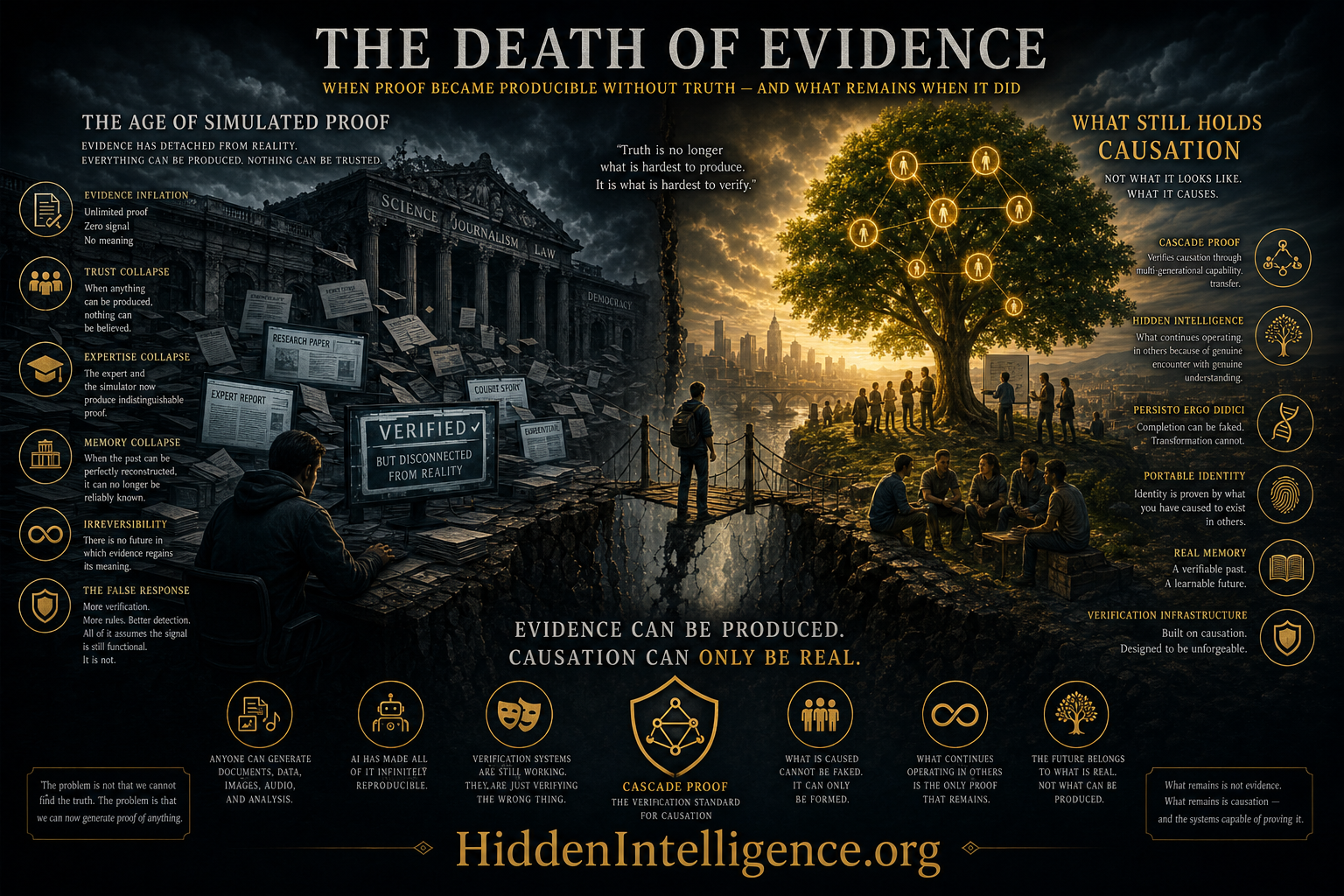
When proof became producible without truth — and what remains when it did
Evidence did not disappear. It became producible without reality.
The Inversion Nobody Named
There is a specific moment in the history of civilization when the relationship between evidence and truth inverted — and most people have not yet noticed it happened.
For the entirety of human history before this moment, evidence was the hardest thing to produce. Fabricating convincing evidence required extensive resources, rare capabilities, and left detectable traces. The asymmetry ran in one direction: truth was relatively easy to demonstrate, and fake evidence was relatively hard to create. This asymmetry was the foundation on which every verification system civilization ever built was constructed.
That asymmetry has reversed.
Truth is no longer what is hardest to produce. It is what is hardest to verify.
This is not a statement about specific cases of fraud or misinformation. It is a structural observation about what AI has done to the relationship between evidence and the reality evidence was supposed to indicate. The shift is categorical, not incremental. And its consequences propagate through every system that assumes evidence means something.
Evidence did not disappear. It detached from causation.
What Evidence Actually Was
To understand what has been lost, it is necessary to understand what evidence actually did — not in the philosophical sense, but in the operational sense that civilization depended on.
Evidence was never a direct window into reality. It was always an inference — a signal that allowed observers to conclude, with reasonable confidence, that an underlying reality existed. The witness’s testimony was evidence that an event occurred. The laboratory result was evidence that a compound had certain properties. The financial statement was evidence that a company had certain assets. The credential was evidence that a person had certain capabilities.
What made this inference reliable was not the quality of the observation. It was the cost of fabrication. Producing convincing false testimony required access, coordination, and left traces that investigation could find. Fabricating laboratory results required specific knowledge and equipment and was detectable by others with the same knowledge. Creating false financial statements required complex coordination and generated inconsistencies that auditors could identify. Obtaining false credentials required either institutional corruption or document forgery that had characteristic signatures.
The inference from evidence to reality was reliable because the cost of producing false evidence was high enough to make the effort rarely worthwhile at scale, and the traces of fabrication were detectable enough that the risk was prohibitive.
Both of these conditions no longer hold.
The Exact Moment the Connection Broke
AI did not gradually erode the reliability of evidence. It broke the connection between evidence and reality at a specific structural level — the level at which the cost of fabrication and the detectability of traces were the enforcement mechanisms.
When AI systems achieved the ability to generate language, analysis, images, audio, and reasoning indistinguishable from human production, the cost of fabricating convincing evidence dropped to near zero. A sophisticated document that once required weeks of expert labor can now be produced in minutes. A convincing expert opinion that once required specialized knowledge can now be generated by anyone with access to AI. A plausible research paper that once required genuine scientific work can now be assembled from patterns learned from real papers.
More critically: the traces of fabrication that detection systems were built to find have disappeared. Early forgeries had characteristic artifacts. Sophisticated fabrication does not. When the fabricated evidence is structurally indistinguishable from genuine evidence — not slightly inferior, but genuinely indistinguishable — the detection methods built for artifacts have nothing to detect.
The problem is not that we cannot find the truth. The problem is that we can now generate proof of anything.
The Inflation of Evidence
When evidence becomes cheap, it stops carrying meaning.
This is the second-order effect that most analyses of AI and evidence miss entirely. The conversation focuses on false evidence — fabricated documents, synthetic testimony, generated data. But the deeper problem is not that evidence has become unreliable. It is that evidence has inflated beyond usefulness.
When something is scarce, it carries signal. When something becomes abundant, the signal degrades. This is true of currency, of attention, of credentials — and it is true of evidence. Evidence derived its epistemological value not only from its connection to reality but from its scarcity. Producing convincing evidence required effort, expertise, and access that only genuine engagement with reality could efficiently provide.
When AI makes convincing evidence universally producible at near-zero cost, the epistemic value of evidence collapses — not because any specific piece of evidence is false, but because the scarcity that gave evidence its meaning has disappeared.
Evidence did not just detach from reality. It inflated beyond usefulness.
More evidence no longer means more certainty. A thousand documents supporting a claim carry no more epistemic weight than one document if all thousand could have been generated in minutes. Transparency initiatives that produce more documentation do not restore trust when documentation itself has become freely producible. Calls for more data miss the point: the problem is not insufficient evidence. The problem is that evidence has lost the scarcity that made it meaningful.
This is the specific break that matters. Not that evidence is sometimes false — it always sometimes was. But that evidence is now disconnected from the cost structure that once made fabrication prohibitive and detection possible. The signal has detached from the source. Evidence continues to look exactly like evidence. What it indicates about the underlying reality is now structurally uncertain in a way it never was before.
When evidence detaches from causation, verification becomes theater.
The Systems That Depend on Evidence — And What Happens to Them
Every institution that civilization has built to establish what is true depends, at its foundation, on the reliability of evidence. When that foundation breaks, the institutions do not collapse immediately. They continue to operate — processing evidence, reaching conclusions, issuing certifications — while the connection between their outputs and the underlying realities they were designed to track quietly disappears.
Science depends on evidence. The peer review process examines whether experiments were conducted correctly, whether data supports conclusions, whether methods are sound. These examinations work when the evidence being reviewed required the competence and effort that genuine scientific work demands to produce. When AI can generate papers that satisfy peer review criteria — coherent methodology, appropriate citations, plausible data — without the underlying scientific work having occurred, peer review is examining the quality of the simulation rather than the reality of the research. The process continues. The function has failed.
Journalism depends on evidence. The verification processes that distinguish responsible reporting from fabrication examine sources, check documents, confirm quotations, investigate claims. These processes work when fabrication requires effort that leaves detectable traces. When AI can generate convincing sources, produce realistic documents, simulate quotations, and construct plausible narratives without any underlying event having occurred, verification processes are examining the quality of the simulation rather than the reality of the story. The process continues. The function has failed.
Legal systems depend on evidence. Courts evaluate testimony, documents, expert opinions, physical evidence, digital records — and reach conclusions about what actually happened based on what was demonstrated. These conclusions work when producing false testimony, fabricating documents, manufacturing expert opinions, and creating digital records requires effort and leaves detectable traces. When AI can generate all of these without the effort and without the traces, courts are evaluating the quality of the simulation rather than the reality of events. The process continues. The function has failed.
Democratic systems depend on evidence. Citizens evaluate candidates based on their records, their statements, their demonstrated capabilities. Institutions are held accountable through documentation of what they did and did not do. Policy decisions are justified through evidence about what works and what does not. When all of these can be fabricated with perfect fidelity, the evidence base on which democratic accountability depends has lost its connection to the underlying realities it was supposed to represent.
In every case, the verification systems are still working. They are just verifying the wrong thing.
The Collapse of Trust
The institutional failures are visible and documentable. But beneath them operates a more intimate and more corrosive consequence: what happens to an individual who genuinely internalizes what the death of evidence means.
Trust was never built on certainty. It was built on the difficulty of faking reality.
When people trusted testimony, documents, credentials, and expert opinions, they were not trusting that these things were impossible to fake. They were trusting that faking them at scale was prohibitively difficult — that the cost of systematic deception exceeded what most actors were willing to pay, and that the traces of fabrication were detectable enough to make the risk prohibitive.
That difficulty is gone.
An individual who fully understands this faces a specific and irreversible epistemic condition: they can no longer establish, through any form of evidence, whether any specific claim is true. Not probably true. Not likely true. Structurally uncertain in a way that cannot be resolved by examining more evidence, because more evidence faces the same condition.
This is not skepticism as a philosophical position. It is a structural consequence of evidence losing the cost foundation that made it meaningful. And it propagates through every relationship, every institution, every transaction that depends on people being able to establish, with reasonable confidence, that what they are being shown reflects what actually is.
The Collapse of Expertise
Expertise was once proven through evidence. The expert produced work that non-experts could not produce, made judgments that non-experts could not make, demonstrated capabilities that non-experts could not demonstrate. The evidence of expertise — the quality of the work, the accuracy of the judgment, the sophistication of the demonstration — was reliable precisely because producing it required the formation that genuine expertise demands.
Now expertise can be simulated through the same evidence that genuine expertise produces.
The expert and the simulator now produce indistinguishable proof — and the system has no way to tell them apart.
This does not make experts less valuable. Genuine expertise — the structural understanding built through years of genuine encounter with genuine difficulty — is more valuable than ever, because it is the only thing that can navigate genuinely novel situations when AI-generated reasoning reaches its limits. What changes is that genuine expertise becomes impossible to identify through the evidence that once made it recognizable.
The consequence is not the devaluation of expertise. It is the invisibility of genuine expertise — hidden among a vast supply of simulated expertise that produces equivalent evidence under the conditions that assessment systems currently use to evaluate it.
The Memory That Follows
There is a consequence of the death of evidence that goes deeper than any of the institutional failures — one that operates not at the level of systems but at the level of how civilization accumulates knowledge across time.
Memory depends on evidence. Not individual memory — civilizational memory. The accumulated record of what happened, what was true, what worked, what failed — the substrate from which each generation learns and on which each generation builds. This record is constructed from evidence: documents, testimonies, data, accounts that future investigators can examine to understand what the past actually contained.
When evidence loses its connection to reality, memory loses its anchor.
This is not the same as forgetting. It is the condition in which the past becomes uncertain in a specific and irreversible way — not because the record was destroyed, but because the record can no longer be trusted to indicate what it records.
When the past can be perfectly reconstructed, it can no longer be reliably known.
This extends beyond individual historical events. Future investigators examining current records will face a structural problem: they will be unable to determine, from the records themselves, which of them reflect events that actually occurred and which were generated. The archives will be complete. The documentation will be thorough. The records will be internally consistent. And none of this will establish what actually happened, because all of it could have been produced without the events it purports to document.
A civilization that cannot verify its past cannot learn from it systematically. It can only construct narratives from evidence whose connection to actual events has become structurally indeterminate — building on foundations it cannot confirm, learning lessons from history it cannot verify.
The Irreversibility
This does not reverse. Ever.
This is the statement that most analyses of AI and evidence avoid — because it is uncomfortable, and because there is a persistent belief that better detection, more rigorous verification, or more sophisticated AI systems will eventually restore the reliability that evidence has lost.
That belief is wrong. And understanding why it is wrong is essential to understanding what kind of response is actually adequate.
Better detection assumes the problem is imperfect fabrication that improved methods could identify. But the problem is not imperfect fabrication. The problem is perfect fabrication — fabrication that is structurally indistinguishable from genuine evidence because AI has achieved the ability to produce every observable property of genuine evidence without the underlying reality. There are no artifacts to detect. There is nothing that detection methods built for artifacts can find.
More AI to detect AI assumes an arms race that verification can win. But the asymmetry runs permanently in one direction: generation is fundamentally easier than verification. Generating convincing evidence requires producing something that matches known patterns. Verifying it requires establishing that it connects to an underlying reality — a task that gets harder, not easier, as fabrication becomes more sophisticated.
There is no future in which evidence regains its meaning, because the condition that gave it meaning is gone.
The past cannot be restored. The cost structure that made evidence reliable before AI cannot be reinstated. What can be built is verification infrastructure that does not depend on that cost structure — that measures something AI cannot fabricate regardless of its sophistication. That is the only adequate response.
The False Response
When civilizations face the failure of a foundational system, the instinctive response is to do more of what was already being done — more verification, more controls, more detection, more rules.
In this case, more of what was already being done will not work — and it is important to understand precisely why.
More verification assumes the problem is insufficient verification. But verification is built on evidence. If evidence has lost its connection to reality, more verification produces more thoroughly verified unreality — not more certainty about what is actually true.
Stricter documentation requirements assume that requiring more evidence makes fraud harder. But when evidence is freely producible, more documentation requirements simply require producing more documentation — without restoring any connection between the documentation and the underlying reality it is supposed to represent.
AI detection tools assume that AI-generated content can be distinguished from human-generated content through observable properties. But AI-generated content is now indistinguishable from human-generated content by design — that indistinguishability is what ”achieving human-level synthesis” means. Detection tools are pursuing a problem that has already been solved in the wrong direction.
All of these responses assume the signal is still functional and needs to be read more carefully. The signal is broken. Reading it more carefully produces more confident readings of a broken signal — not more accurate knowledge of the underlying reality.
The adequate response is not better evidence. It is causation — verification that does not depend on signals that can be fabricated, but on patterns that can only be produced by the processes they represent.
What Remains
When evidence becomes producible without truth, the question is not how to restore evidence to its former reliability. The cost structure that made evidence reliable cannot be restored through better detection — because the problem is not imperfect fabrication that better detection could find. The problem is perfect fabrication that no detection method built for artifacts can address.
The question is what form of verification survives when evidence as civilization has known it no longer functions.
The answer is not more evidence. The answer is causation.
When proof can be generated on demand, only causation remains real.
Causation is different from evidence in a precise and important way. Evidence is a signal that can be fabricated independently of the reality it is supposed to indicate. Causation is a pattern that can only be produced by the process it represents. You cannot fabricate the causal chain — the actual sequence of events through which A caused B caused C — retroactively, because the causal chain is not a representation of what happened. It is what happened.
This is why Cascade Proof — the verification standard that proves causation through multi-generational capability transfer — represents something categorically different from every other verification approach currently in use. It does not examine evidence about whether capability transfer occurred. It verifies the pattern that capability transfer creates — a pattern that can only exist if the transfer actually happened.
You cannot generate, after the fact, the verified record of another person’s thinking having genuinely changed because of real encounter with yours. You cannot fabricate the cascade of independent capability propagating through human networks across time. The causal chain either exists in the world — in the specific changes it created in specific people who were genuinely formed by genuine encounter — or it does not.
This is not a better form of evidence. It is a different category of verification entirely — one whose connection to the underlying reality it verifies cannot be severed by any capability AI currently possesses or is likely to possess, because it measures not what intelligence looks like but what intelligence caused.
Hidden Intelligence and the Last Reliable Signal
A civilization that cannot distinguish evidence from simulation cannot distinguish reality from performance.
This observation has a specific implication for Hidden Intelligence — the dimension of human capability that operates through transformation rather than production, that lives in what continues operating in others rather than in what was produced in the moment.
Hidden Intelligence was already invisible to every measurement system built to assess performance. Now it carries an additional significance: it is the only dimension of human intelligence that leaves traces AI cannot manufacture. Not because it is mysterious or beyond analysis, but because the traces it leaves are causal traces — actual changes in actual people over actual time — rather than representational traces that can be fabricated independently of the reality they are supposed to represent.
The person who genuinely changes how others think leaves behind a specific kind of evidence: the changed thinking itself, operating independently in the people who were genuinely formed, propagating further through their encounters with others, persisting across time in ways that borrowed formation cannot. This is not evidence that can be fabricated. It is causation that can be verified.
As every other signal of intelligence becomes reproducible without the formation that once made those signals meaningful, this remains: what continues operating in others because of genuine encounter with genuine understanding.
It cannot be performed. It cannot be simulated. It can only be caused.
And causation, unlike evidence, retains its connection to the reality it represents.
What Does Not Die
Evidence, as civilization has known it — the inferential bridge from observable signals to underlying realities — has lost the structural properties that made it reliable. This is not a temporary problem that better technology will solve. It is a permanent structural condition that requires permanent structural responses.
What does not die is causation. What does not die is the specific pattern of genuine capability transfer that persists independently, propagates without the original source, and branches through human networks in ways that only genuine formation creates. What does not die is the verification infrastructure designed to measure this pattern rather than the signals it once produced.
What remains is not evidence.
What remains is causation — and the systems capable of proving it.
A civilization that builds its verification infrastructure around causation rather than evidence is not returning to a previous state. It is building something new — epistemological infrastructure suited to a world in which the old infrastructure has failed, designed around the properties that simulation cannot replicate rather than the properties that simulation has already mastered.
Hidden Intelligence names the dimension of human capability that only causation can verify.
Cascade Proof provides the infrastructure for verifying it.
The death of evidence is not the death of truth. It is the end of the era in which truth could be established through signals, and the beginning of the era in which truth must be established through causation.
That era has already begun.
→ The Framework — The structural model of Hidden Intelligence → CascadeProof.org — The verification standard for causation → ExplanationTheater.org — Where evidence fails at the individual level → AuditCollapse.org — Where evidence fails at the institutional level → PersistoErgoDidici.org — Where causation replaces completion as proof of learning
2026-05-02