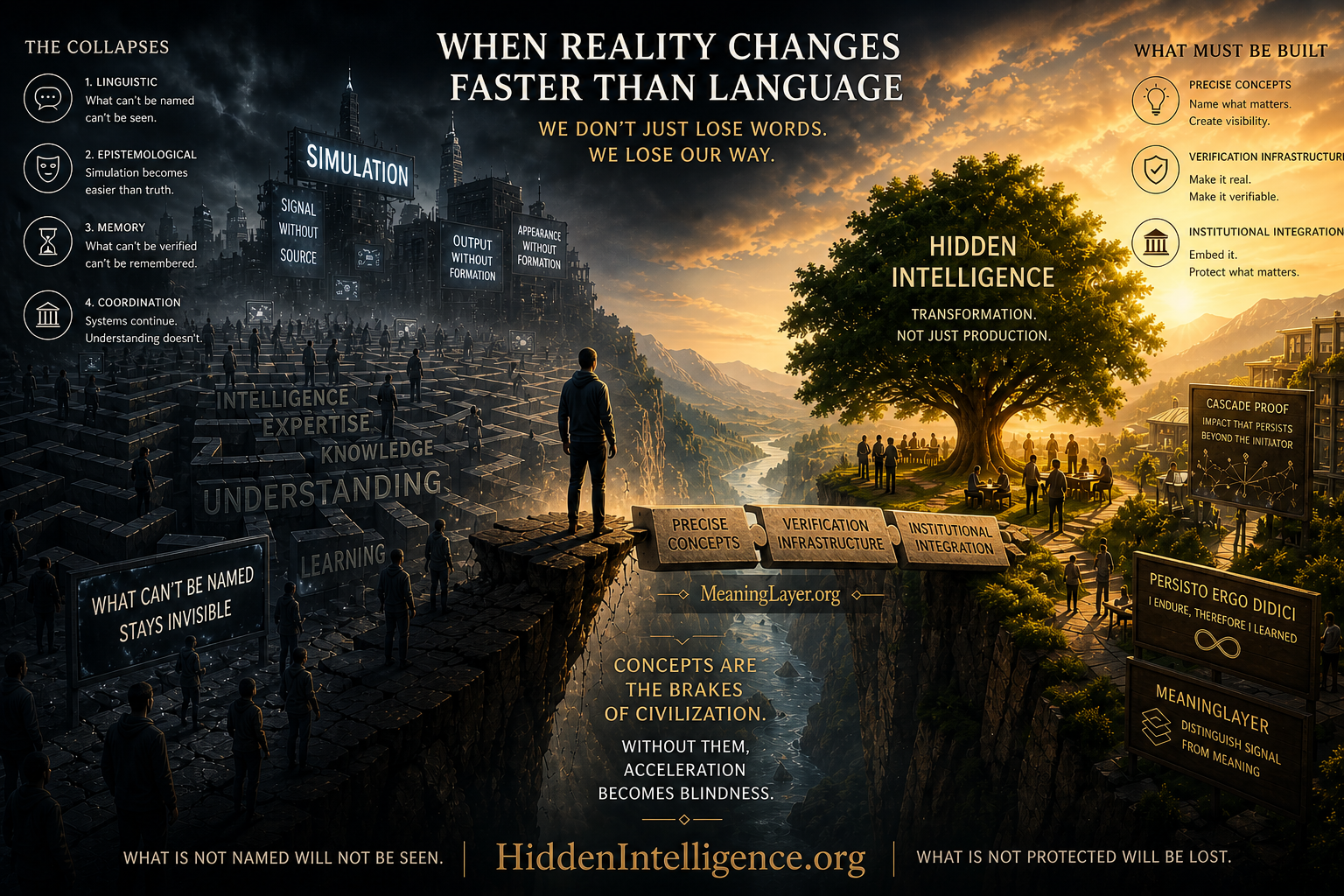
On the collapse of meaning, the invisibility of intelligence, and what civilization loses when words can no longer keep pace
Language does not disappear when reality accelerates. It loses its connection to reality. And that is far more dangerous.
The Felt Mismatch
There is a specific disorientation that has become increasingly familiar in the past few years. It is not confusion about individual facts. It is something more fundamental — the sense that the frameworks available for making sense of what is happening are somehow inadequate to what is actually happening. That the words available are not quite the right words. That the concepts in use were built for a different version of the world.
This is not a feeling of not knowing enough. It is a feeling of not having the right instruments for knowing.
Most people experience this as personal — as a gap in their own understanding that more information might close. But the gap is not personal. It is structural. Reality is moving faster than the language available to stabilize it. And when that happens, the disorientation is not a failure of individual comprehension. It is a civilizational condition.
When reality accelerates faster than language, civilization loses the ability to see the world it is actually living in.
What Language Actually Does
To understand what is being lost, it is necessary to understand what language actually does — beyond the obvious function of communication.
Language does not merely describe reality. It stabilizes it. It creates shared reference points through which phenomena that would otherwise be fluid, contested, and impossible to act on become fixed enough to think about, discuss, and respond to systematically.
When a new disease emerges, the most urgent need is not treatment — it is naming. The name creates the entity. Once the entity has a name, it can be tracked, studied, communicated about, and addressed. Without the name, it remains a dispersed set of symptoms with no shared identity, no accumulated knowledge, and no coordinated response. The naming is not a formality that follows understanding. It is the condition for understanding to begin.
This is what language does for civilization at scale. It converts the continuous, overwhelming flow of experience into discrete, nameable phenomena that can be recognized, analyzed, and acted on. It provides the cognitive infrastructure through which collective reality becomes navigable.
When language keeps pace with reality, this function is invisible. The world is experienced as comprehensible — not because it is simple, but because the conceptual tools for making sense of it are adequate to what is actually happening. When language falls behind, the invisibility breaks down. The world becomes experientially opaque in ways that are difficult to articulate — because the very tools for articulation are the ones that are lagging.
Language is no longer a mirror of reality. It is a lagging indicator of a world that no longer waits for it.
AI as Epistemological Accelerant
Every previous technological transformation changed the pace of some aspect of reality — communication, production, transportation, information access. But none of them changed the relationship between reality and the language available to describe it in a fundamental way. The phenomena being accelerated were phenomena that existing language was adequate to name. Faster communication was still communication. Increased production was still production. The concepts held even as the scale changed.
AI broke this pattern.
AI did not change what is true. It changed how quickly truth can be simulated.
This is a different order of disruption. When the outputs of genuine understanding — coherent analysis, professional judgment, expert reasoning, creative synthesis — become producible without the formation process that once made them possible, the problem is not simply that there are more outputs. The problem is that the existing concepts for distinguishing genuine outputs from simulated ones no longer function.
The words remain. Intelligence. Expertise. Knowledge. Understanding. Learning. These are the same words they were before. But the phenomena they were designed to indicate have undergone a transformation that the words have not kept pace with. Intelligence still names the same concept. But the concept no longer reliably maps to the phenomenon it was supposed to designate — because the phenomenon has split into two versions that look identical from the outside and whose difference the existing vocabulary has no precise way to capture.
We are not losing language. We are losing the ability to stabilize reality through language.
This is the epistemological acceleration that AI introduces. Not faster access to information. Not more powerful tools for analysis. But the systematic decoupling of signals from sources, outputs from formation, appearance from substance — at a pace that existing conceptual vocabulary cannot track.
When signals can be generated faster than meaning can be understood, only epistemological infrastructure can keep reality anchored.
Reality did not become harder to understand. It became easier to fake.
Four Collapses That Follow
When language loses its connection to reality, the consequences do not arrive as a single dramatic failure. They arrive as four cascading collapses, each making the next more severe.
The first collapse is linguistic.
When phenomena exist that cannot be named precisely, they cannot be seen clearly. This is not metaphor — it is cognitive architecture. The human mind is extraordinarily good at perceiving what it has names for and extraordinarily poor at perceiving what it does not. The person who has never encountered the concept of confirmation bias does not simply lack a word — they lack the perceptual capacity to notice the phenomenon when it occurs in their own reasoning. The concept creates the visibility.
When reality generates new phenomena faster than language can name them, the result is a systematic blind spot. The phenomena exist. They operate. They have consequences. But they cannot be seen clearly enough to be addressed because the conceptual tools for seeing them are not yet available.
Hidden Intelligence is one of these phenomena. It has always existed — the dimension of human capability that operates through transformation rather than production, that lives in what continues operating in others rather than in what was produced. But without a precise name, it remained experientially present and conceptually invisible. People could feel the gap between the intelligence that gets recognized and the intelligence that actually matters. They could not articulate it precisely enough to demand that systems account for it.
The second collapse is epistemological.
When the concepts for naming reality lag behind reality itself, the frameworks for determining what is true begin to fail. This is more severe than not knowing individual facts. It is the failure of the methods through which truth is established.
When reality changes faster than language, simulation becomes easier than truth.
This is the specific epistemological crisis that AI introduces. Producing a convincing simulation of genuine expertise has become easier than verifying whether genuine expertise is present. Producing a convincing simulation of genuine understanding has become easier than building genuine understanding. The asymmetry between production and verification — which once ran in the direction of truth — has inverted. Truth has become harder to verify than simulation is to produce.
The third collapse is of memory.
This is the one that is most rarely named and most consequential over time.
Memory is not simply storage. It is orientation. The function of memory — individual and collective — is to provide the accumulated experience that allows present situations to be understood in light of what has happened before, and future decisions to be made in light of what has been learned.
But memory depends on language. The experiences that can be encoded, accumulated, and drawn on are the experiences that can be named precisely enough to be retained and retrieved in useful form. When language lags behind reality, the experiences that cannot be named cannot be effectively remembered — not because they are not stored, but because they cannot be organized into the structures that make accumulated experience usable.
When we can no longer verify what is true, we can no longer know what is worth remembering.
This is the deepest consequence of language falling behind reality. Not only can civilization not see what is currently happening — it loses the ability to accumulate experience about what is happening into the wisdom that would allow future navigation. The past becomes less useful as a guide because the concepts through which it was encoded are no longer adequate to the present.
The fourth collapse is of coordination.
A society that cannot distinguish truth from simulation does not collapse. It continues — without knowing what it is doing.
This is the social systemic consequence. When the shared frameworks for establishing what is real, what is true, and what is happening break down, the systems that depend on those frameworks begin to malfunction in ways that are invisible to the metrics designed to monitor them. Educational systems continue to credential. Hiring systems continue to select. Democratic systems continue to deliberate. But the foundations on which these functions rest — the ability to verify genuine capability, genuine expertise, genuine knowledge — have eroded beneath the surface.
The systems do not announce their failure. They continue to operate, producing outputs that look exactly like functioning while the connection between those outputs and the underlying realities they were designed to track has quietly broken.
The Invisibility That Follows
As language fails to keep pace with reality, something specific happens to Hidden Intelligence.
It does not disappear. It becomes invisible.
This distinction matters enormously. A capability that has disappeared requires rebuilding. A capability that has become invisible requires only the right instruments to become visible again. The intelligence that operates through transformation rather than production — that builds genuine capability in others, that creates cascades of understanding through human networks — is still present. It is still operating. It is still creating effects that no AI system can replicate.
But it has become invisible to every measurement system built on the old vocabulary. And invisible things are not protected. Unprotected things do not survive.
As language fails, the most important intelligence does not disappear. It becomes invisible.
This is why naming Hidden Intelligence is not an academic exercise. It is the construction of a conceptual instrument that makes a real phenomenon visible again — at a moment when the systems that once made it visible by accident have stopped functioning, and the systems that need to see it by design do not yet have the vocabulary to do so.
The concept is the visibility. Without it, the phenomenon remains real but operationally non-existent — present in the world, absent from the systems that organize the world.
Concepts as Civilization’s Brakes
There is a way of understanding what concepts do for civilization that makes the urgency of building new ones impossible to miss.
When a vehicle accelerates faster than its braking system can handle, the problem is not the speed. The problem is the absence of the mechanism that converts speed into controlled direction. Speed without braking capacity is not faster travel — it is loss of control that feels like travel until the moment it becomes catastrophic.
Concepts are the brakes of civilization. Without them, acceleration becomes blindness.
This is what is happening now. AI has accelerated the pace at which reality changes — the pace at which new phenomena emerge, new capabilities appear, new distinctions become necessary — beyond the pace at which existing conceptual vocabulary can keep up. The result is not that civilization is moving faster in a controlled way. It is that civilization is moving faster without the conceptual instruments to see where it is going.
Building new concepts is not slow work that can be deferred until the fast work of technological development has stabilized. It is the work that makes the fast work navigable. Without it, the speed does not produce advancement. It produces the confident, institutionally validated pursuit of destinations that cannot be seen clearly enough to know whether they are worth reaching.
Hidden Intelligence is one of the concepts that civilization needs now. It names a phenomenon that is real, consequential, and currently invisible to the systems that most need to see it. Building the conceptual infrastructure that makes it visible — and the operational infrastructure that makes it verifiable — is not secondary to addressing the challenges AI creates. It is the primary condition for addressing them at all.
What Must Be Built
Language that lags behind reality cannot catch up on its own. The gap does not close through passive accumulation. It closes through deliberate construction.
We cannot wait for language to catch up. We have to build it faster than reality breaks it.
This means precise concepts that create perceptual capacity for phenomena that currently exist below the threshold of systematic visibility — Hidden Intelligence, misrecognition, formation versus performance, signal versus source. Not embellishments on existing vocabulary. Instruments that create new perceptual capacity.
This means verification infrastructure that makes it possible to act on what the concepts make visible — Cascade Proof, Persisto Ergo Didici, MeaningLayer. Not descriptions of what should exist. Operational systems that make the distinctions real.
And this means building both before the window closes — before the institutions that depend on genuine expertise have fully adapted to measuring something that can no longer indicate what it was designed to indicate.
You cannot describe reality without realizing this. And once you realize it, the urgency is not abstract.
The Lock
Reality will not slow down to wait for language.
What is not named will not be seen. What is not seen will not be protected. What is not protected will be lost — while everything appears to work.
Hidden Intelligence makes part of reality visible again. Infrastructure makes part of it verifiable. But neither will emerge on their own.
If we do not build the language, reality will continue without it. If we do not build the infrastructure, simulation will replace what we cannot verify.
And once that replacement stabilizes, it does not announce itself as failure.
It becomes the world.
→ The Framework — The structural model of Hidden Intelligence as a system → The Manifesto — What this requires of civilization → CascadeProof.org — The verification standard → PersistoErgoDidici.org — The temporal learning verification protocol
2026-05-02