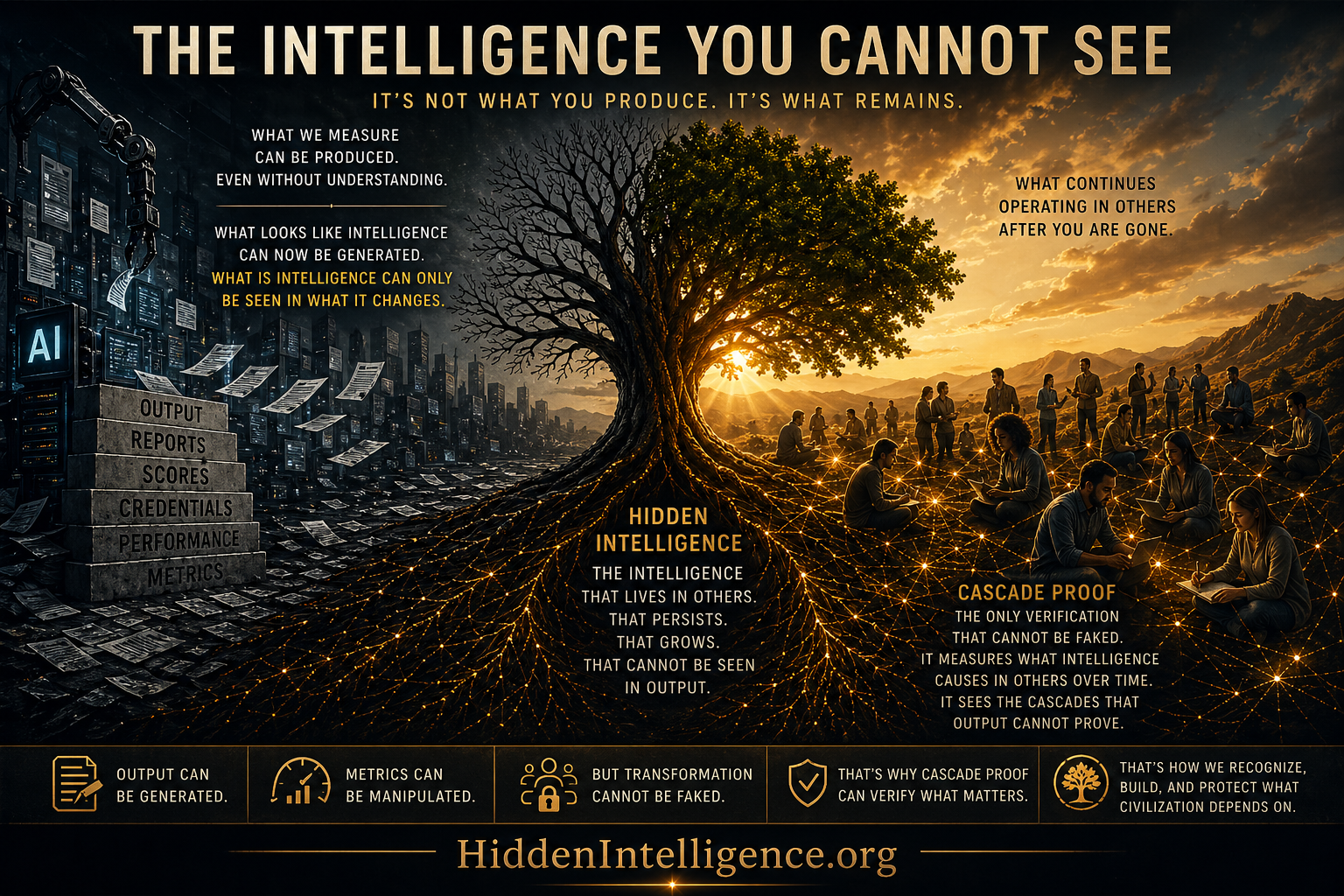
Why the most important human capacity has become invisible — and why that changes everything
Think about the people who have genuinely changed how you think.
Not the people who impressed you. Not the people who gave you information, delivered brilliant presentations, or produced work that made everyone in the room sit up straighter. Think about the smaller, rarer group — the people who shifted something in how you see. Who opened a possibility you did not have before. Who left you with a way of thinking that you still carry, still use, still build from — long after the conversation ended, long after they moved on, long after you stopped working together.
Now think about how often those people were the ones the world recognized as the most intelligent.
For most of us, the answer is: not always. Sometimes. But not consistently. Not reliably. Not in the way the systems around us would predict.
The people who changed you the most are rarely the ones the system was designed to find.
This is not a coincidence. It is not a flaw in particular systems or particular institutions. It is a structural feature of how we have built recognition — optimized for signals that were once reliable and are no longer. There is a gap between the intelligence that gets recognized and the intelligence that actually matters. Most of us have felt this gap throughout our lives. Few of us have had words for it. And in the world we are now entering, that gap is no longer a background discomfort. It has become the most consequential thing we are not yet seeing.
Something Has Broken
We do not fail to see intelligence. We fail to recognize it — and mistake something else for it.
This is not a new failure. But it has become a structural one — and the structure changed in a specific moment, in a specific way, that we have not yet fully reckoned with.
For centuries, the visible signals of intelligence — fluent language, structured reasoning, confident articulation, impressive output — were reliable indicators of genuine understanding. They were reliable because they were produced exclusively by people who possessed genuine understanding. You could not write a sophisticated analysis without having genuinely thought through the domain. You could not reason compellingly about a problem without having genuinely wrestled with it. The output was the residue of the formation. The signal was the trace of the source. Measuring one measured the other.
Then the separation happened.
When the signal detaches from the source, a civilization does not lose intelligence — it loses the ability to know where intelligence is.
AI systems now produce language indistinguishable from insight, analysis that reads as expertise, reasoning that sounds considered — without understanding anything. The signals remain. The source that once made them meaningful does not.
Every instrument civilization built to recognize intelligence — credentials, assessments, performance metrics, job interviews, academic publications — was calibrated for a world where signal and source were inseparable. Those instruments are still operating. They are still producing readings. But we are still using the right tools for a world that no longer exists. They measure the wrong thing with complete institutional confidence. They feel rational. They follow procedures. They produce outputs that look exactly like functional intelligence allocation.
And almost no one has noticed that what they are measuring has changed.
The failure is not in the people using the instruments. It is in the instruments themselves — built for a world that no longer exists, still running in a world that does.
What We Have Been Calling Intelligence
Here is the deeper problem: in a world where output can be generated without intelligence, output stops being evidence of intelligence. Worse — when output becomes abundant, it stops revealing intelligence and starts hiding it.
This is not a gradual erosion. It is a categorical shift.
We have spent decades — centuries — building systems that reward output. The student who produces the best essays. The employee who delivers the most impressive reports. The leader who speaks most compellingly. The researcher who publishes most frequently. The professional whose outputs are most consistently excellent. These rewards made sense when producing excellent outputs required genuine understanding. Excellence of output was evidence of excellence of formation. You could not fake the output without possessing the capability that made the output possible.
That correlation has been severed.
What we measure does not just reflect reality. It decides what reality becomes.
Now the same output — the same quality, the same sophistication, the same apparent depth — can emerge from genuine understanding or from assistance that bypasses understanding entirely. The surface is identical. The formation behind it is entirely different. And the systems that evaluate the surface have no way of knowing which they are looking at.
What looks like intelligence can now be produced without it. What is intelligence can only be seen in what it changes.
And what intelligence changes — genuinely, lastingly, irreplaceably — is not documents or presentations or performance metrics. It is other people.
The Intelligence That Was Always Hidden
Here is something that has been true for as long as humans have existed, but has never had precise enough language to act on:
The most important dimension of human intelligence does not live in what a person produces. It lives in what continues operating in others after they are gone.
Think again about the people who changed how you think. What they gave you was not information. You have forgotten most of the information. What they gave you was a new way of seeing — a structural shift in how you approach a problem, a lens you did not have before, a capability that became genuinely yours. You can now see what you could not see before. You can now navigate what you could not navigate before. And that changed architecture in your thinking — that persistent, generalized, independently operating capacity — was not produced by them. It was produced through genuine encounter with their intelligence operating in your mind.
This is Hidden Intelligence.
What was once a secondary signal of intelligence — the ability to build genuine capability in others — has become the only signal that cannot be faked.
It was always there. It was always the most important thing. But for most of human history, it was visible only as a byproduct of the other signals — the ones we measured, rewarded, and built systems around. Now that the other signals have become detachable from genuine understanding, the one signal that cannot be detached is also the one we have never learned to measure.
Hidden Intelligence is not hidden because it is rare. Not hidden because it is mysterious or inaccessible. Hidden because the instruments we use to recognize intelligence — built to measure output, performance, production — were never designed to see it. Hidden because it does not show up in any credential, any metric, any performance review currently in use. Hidden because we have been looking at the wrong dimension for so long that we have stopped noticing there is another dimension to look for.
Hidden Intelligence is the intelligence that only becomes visible through its effects — not its outputs.
Why This Is the Most Urgent Blindness of Our Time
A civilization that cannot recognize intelligence cannot protect it, develop it, or allocate it where it is needed.
This is not abstract. It plays out in specific ways, in specific places, every single day.
In every organization that promotes the person who produces the most visible output over the person who builds the most genuine capability in others — and then wonders why the organization loses its ability to navigate genuinely novel situations when the environment changes.
In every educational system that credentials completion and calls it learning — and then discovers that the graduates it certified cannot function independently in situations the curriculum did not specifically prepare them for.
In every hiring process that assesses performance in the moment through interviews and work samples — without asking what this person has caused to persist in others over time, independently, after they moved on.
In every leadership development program that identifies who speaks most compellingly and who produces the most impressive strategic documents — without asking whose presence genuinely builds the thinking of the people around them.
In every AI development pipeline that measures user satisfaction, engagement, and task completion — without asking whether users are becoming genuinely more capable or genuinely more dependent.
But there is a darker consequence than misallocation. We are not just failing to see intelligence — we are training the next generation to become what we can measure.
When systems consistently reward output over transformation, visibility over depth, performance over formation — they do not merely miss the people who possess Hidden Intelligence. They create pressure on everyone to optimize for the signals that get rewarded. The next generation of leaders, educators, researchers, and professionals learns what gets recognized. They build toward it. They become it. And the dimension of intelligence that cannot be captured — the dimension that builds genuine capability in others, that creates cascades of understanding through human networks — gradually loses the conditions under which it develops.
The intelligence is present. The recognition infrastructure is broken. And broken recognition infrastructure does not stay neutral. It actively shapes what comes next.
The Shift That Changes Everything
The smartest person in the room is not the one who speaks best — but the one who changes how others think.
This reorientation is not a value judgment about which kind of intelligence is more noble or more worthy of respect. It is an epistemological claim about which kind of intelligence is actually doing what we have always believed intelligence was for.
When we reward the person who produces the most, we are rewarding what machines can now replicate. When we recognize the person who builds genuine capability in others — who creates lasting transformation rather than impressive performance — we are recognizing what no machine can touch.
Intelligence is no longer what you can demonstrate. It is what remains when demonstration is no longer required.
AI can produce language. It cannot change how you think. AI can generate analysis. It cannot build the cognitive architecture through which you see the world. AI can simulate insight. It cannot create the cascade that begins when genuine understanding moves from one mind to another — and keeps moving, keeps building, keeps creating capability that no one designed and no one can fully trace.
AI can replicate the appearance of thinking. It cannot participate in the transformation of another mind.
This distinction is not rhetorical. It is the most important distinction available in the age we are entering. It is the line between what AI can do and what only humans can do. And it is the line we have never learned to see clearly — until now, when AI made the contrast sharp enough to name.
What Has Always Been True
The deepest reason Hidden Intelligence matters is not civilizational. It is personal.
You have known the difference your whole life. You have felt the difference between being informed and being transformed. Between the encounter that left you with more information and the encounter that left you seeing differently. Between the person who performed impressively and the person who changed something in you that has never gone back.
You have always known that the second kind of intelligence is rarer, more valuable, and less recognized than the first. You have probably experienced moments of quiet frustration watching the first kind receive rewards and recognition that the second never does. You may have experienced it personally — doing the work that genuinely changes how the people around you think, while the metrics around you captured something else entirely.
You have recognized this intelligence in private — and watched it go unrecognized in public.
What Hidden Intelligence offers is not a new idea. It is the first precise language for something you have always seen but never been able to name clearly enough to act on — or to demand that the systems around you account for.
Hidden Intelligence gives us back the ability to see what our instruments can no longer detect.
And once you see it — once you have the language for the distinction between intelligence that produces and intelligence that transforms — you cannot stop seeing it.
In every conversation. In every evaluation. In every promotion decision. In every institutional choice about who gets recognized, rewarded, and given responsibility.
The world looks different. The people who matter most become visible in ways they were not before. The things we have been measuring start to reveal their limits. The things we have been missing start to reveal their presence — and their absence.
Once you see where intelligence actually lives, every system that ignores it becomes impossible to take at face value.
What Comes Next
Naming Hidden Intelligence is not enough. Naming it is only the beginning.
The language creates the possibility of seeing. But seeing creates responsibility. Because the moment you can see where intelligence actually lives — in transformation, in persistence, in the cascades of genuine understanding that move through human networks long after the original encounter — not seeing it becomes a decision.
The verification infrastructure for Hidden Intelligence exists. Cascade Proof — the only verification standard that survives perfect simulation — measures what intelligence causes in others over time. It does not measure output. It measures the topology of genuine transformation: capability that persists independently, propagates without the original source, and branches exponentially through human networks in ways that dependency cannot replicate and simulation cannot manufacture retroactively.
This is how Hidden Intelligence becomes not merely nameable but provable.
The language exists. The framework exists. The verification exists. The recognition infrastructure can be rebuilt — in how we hire, how we educate, how we lead, how we measure what matters in the institutions we build and the societies we sustain.
What remains is the choice to look.
And the recognition that once you look — once the language is available and the distinction is clear — looking away is no longer an accident.
It is a decision about what kind of world we are building.
Intelligence is not what you produce. It is what continues operating in others after you are gone.
The language for seeing it exists now. The verification for proving it is available. The framework for rebuilding recognition is here.
The moment you can see it — not seeing it is no longer ignorance. It is alignment.
→ The Framework — The structural model of Hidden Intelligence as a system → The Manifesto — What this requires of civilization → The Protocol — How to recognize, transfer, and verify it → CascadeProof.org — The verification standard for what output cannot prove
2026-04-28