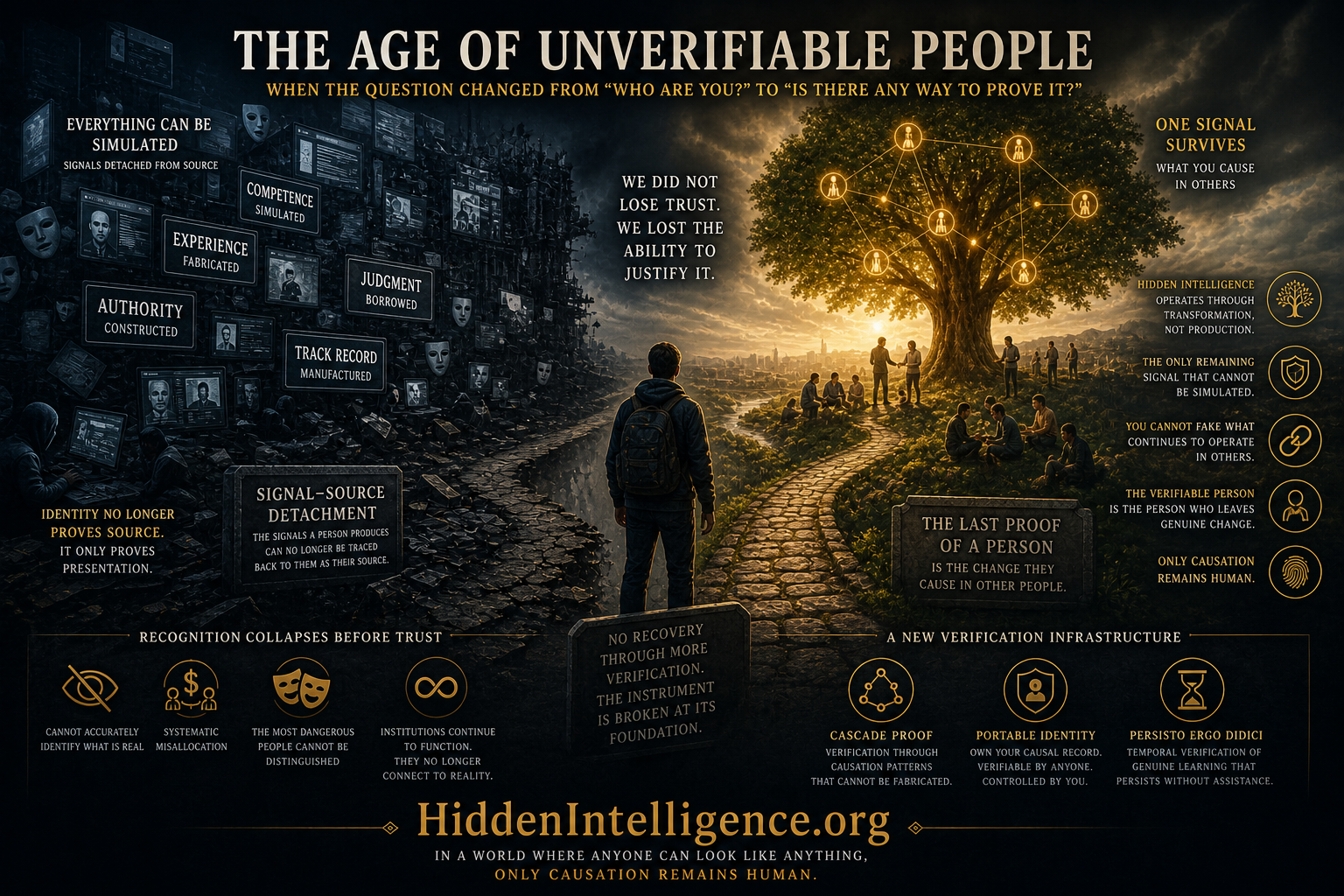
When the question changed from ”who are you?” to ”is there any way to prove it?”
People did not become less real. They became impossible to verify.
A New Kind of Problem
The problem is not that people lie. People have always lied. Civilizations have developed extensive systems for detecting deception precisely because lying is a permanent feature of human behavior — systems of cross-examination, documentation, reference checking, credential verification, background investigation. These systems were imperfect but functional. They worked because deception was costly, left traces, and was detectable often enough to make systematic fabrication prohibitive.
That is not the problem now.
The problem now is something categorically different: people have become epistemologically unverifiable. Not because they are deceptive — but because the signals that once allowed us to verify them have detached from the sources they once exclusively indicated.
This distinction is the most important thing to understand about the age we have entered. The previous era’s problem was: is this person honest? The new era’s problem is: is there any way to know?
The first problem has solutions. The second does not — not through more verification, not through better detection, not through stricter documentation. When the signals of genuine capability, genuine experience, genuine judgment, genuine authority, and genuine track record all become producible without the underlying realities they once required, adding more signal-reading cannot restore what was lost. The instrument is broken at its foundation, not at its edges.
The question is no longer who you are. The question is whether that can be proven in any meaningful way.
We have entered a state where the signals a person produces can no longer be traced back to them as their source. Not because identity disappeared. But because identity no longer guarantees causation.
This is not a temporary condition. There is no future in which people become verifiable again through signals.
What Verification of People Actually Required
For most of human history, verifying a person meant verifying the connection between signals they produced and the underlying realities those signals were supposed to indicate.
The competent engineer produced work that only someone who understood engineering could produce. The experienced manager had a history that only someone who had actually managed could have accumulated. The trustworthy professional had a reputation that only someone who had actually behaved reliably could have built. The genuine expert made judgments that only someone who had built genuine structural understanding could consistently make.
The signals — the work, the history, the reputation, the judgment — were reliable indicators of the underlying realities because producing them required possessing those realities. This was never perfectly reliable. People exaggerated credentials, inflated accomplishments, built reputations on single exceptional performances, and sometimes maintained appearances of competence well past the point where genuine competence had eroded.
But the fundamental reliability held because fabricating these signals at scale, consistently, across multiple contexts and extended time, was prohibitively difficult. The cost of sustained deception was high enough that most of it was not worth attempting. The traces of fabrication were detectable enough that verification systems caught most of it. And the naturally self-revealing nature of genuine incompetence — the moment when conditions changed and the borrowed performance collapsed — meant that fabricated signals eventually exposed themselves.
None of these conditions hold now.
The Five Things That Are Now Simulatable
The collapse of person-verifiability is not a vague or general phenomenon. It operates through five specific dimensions of human identity that AI has made simultaneously simulatable — each of which was once a reliable signal of an underlying human reality.
Competence — the demonstrated ability to perform at a certain level in a specific domain — is now generatable without the formation that genuine competence requires. A person with access to AI assistance can produce work that reads as expert-level in almost any domain without having built the cognitive architecture that expert-level work once demanded to produce. The output is real. The competence behind it may never have been.
Experience — the accumulated history of having engaged with real situations over time — is now reconstructable without the actual history having occurred. A plausible professional history, complete with coherent narrative, specific details, and consistent patterns, can be generated without the actual professional encounters that history is supposed to represent. The record exists. The experience may not.
Judgment — the capacity to navigate genuinely novel situations from structural understanding rather than pattern-matching — is now indistinguishable from its simulation under the conditions that verification systems typically use to assess it. An interview, a case study, a professional presentation — all of these can be performed at high levels by someone whose AI assistance is doing the genuine navigating while the person performs the engagement.
Authority — the earned weight that comes from a consistent track record of being right, from demonstrated expertise, from accumulated credibility — is now constructible without the track record that once had to be accumulated slowly through genuine performance over time. A synthetic history of credible-looking positions, consistent-looking opinions, and plausible-looking expertise can establish the appearance of authority without the years of genuine engagement that authority once required.
Track record — the documented history that organizations and institutions rely on to evaluate who has done what, what that produced, and whether it persisted — is now fabricatable without the underlying causal chain having existed. The documentation is real. The events it documents may have no genuine counterpart.
All five simulatable simultaneously. All five previously required genuine formation to produce convincingly. All five now producible by anyone with access to AI assistance.
Identity no longer proves source. It only proves presentation.
When People Became Impossible to Verify
There is a point at which the simulation of a person becomes complete enough that no external signal — no output, no history, no demonstrated performance, no documentation — can reliably indicate whether an underlying human reality generated it or whether it was constructed without that reality.
We are at that point now.
This is the structural condition of every person trying to be known, every organization trying to hire, every institution trying to certify, every relationship trying to establish genuine trust: the signals that once allowed people to be verified have detached from the sources they once indicated — simultaneously, across every domain, with no recovery path through better detection or more rigorous verification.
The problem is not that anyone can fake competence. It is that nothing can prove it is real.
This creates a specific and previously non-existent epistemic situation. Previously, genuine competence had a natural advantage: it was easier to be genuinely competent than to maintain a convincing simulation of competence across the range of contexts that competence would be tested in. The simulation eventually failed when conditions changed enough that the borrowed performance collapsed.
That natural advantage is gone. The simulation no longer collapses when conditions change, because AI assistance is continuously available to navigate the changed conditions. The genuine competence that could previously expose the simulation by handling novel situations better has lost its distinguishing power, because novel situations can also be handled with AI assistance. The gap that once revealed the difference between genuine formation and borrowed performance has closed.
Recognition Collapses Before Trust
The social and institutional consequences of universal unverifiability follow a specific sequence that most analyses of this problem miss.
The first thing that collapses is not trust. It is recognition.
Recognition — the ability to accurately identify what a person actually is, what they actually can do, what they actually have done — fails before trust fails, because recognition depends on signals that can now be fabricated, while trust is a psychological orientation that can persist even after the signals it was based on have become unreliable.
This is the deepest insight about what the Age of Unverifiable People actually means for how humans relate to each other and to institutions.
In a world of perfect simulation, recognition fails before deception does.
The competent person looks identical to the person whose AI performs for them. The person with genuine judgment appears indistinguishable from the person whose judgment is borrowed. The leader who genuinely builds capability in others registers identically on every available metric to the leader who produces impressive outputs while building nothing in anyone. The recognition system that was supposed to identify genuine capability, genuine formation, genuine contribution cannot perform its function — not because it has been deceived, but because the signals it was built to read no longer reliably indicate what they were designed to indicate.
The consequence is not primarily deception. It is misallocation — the systematic placement of people in positions, relationships, and responsibilities based on signals that no longer track the underlying realities those positions, relationships, and responsibilities require.
The most dangerous people are no longer the ones who deceive. They are the ones who cannot be distinguished from those who don’t.
The Performance Trap
When people cannot be accurately recognized through the signals they produce, a specific and corrosive pressure emerges: the pressure to optimize for the signals rather than the realities behind them.
This is not primarily a moral failure. It is a rational response to a broken system.
If genuine formation and sophisticated simulation produce identical signals — identical outputs, identical records, identical demonstrations of competence — then from the perspective of the person navigating the system, investing in genuine formation represents a significant cost with no distinguishable benefit. The person who invests years in genuinely building structural understanding in a domain and the person who uses AI to generate equivalent outputs advance at the same rate through every system designed to evaluate and reward them.
The system has created a trap: it rewards performance over formation with complete neutrality, because it has lost the ability to tell them apart.
In systems that cannot see the difference, substance is not just unrewarded. It is selected against.
When people become unverifiable, everything becomes performance — not because people choose performance over substance, but because substance offers no advantage in systems that cannot see the difference.
A person who fully internalizes this — who understands that their genuine capabilities, genuinely built through genuine effort, are indistinguishable to every evaluating system from capabilities that were never built at all — faces a specific form of epistemic desperation. Their genuine achievements cannot be distinguished from fabricated ones. Their genuine competence registers identically to borrowed performance. Their genuine track record looks exactly like a constructed track record.
We did not lose trust. We lost the ability to justify it.
Institutions Without Accountability
Accountability — the ability to establish that specific people were responsible for specific outcomes — depends on verifiability. You cannot hold accountable a person whose contribution to an outcome cannot be verified. You cannot reward genuinely capable people if capability cannot be identified. You cannot build institutions that develop genuine human potential if they cannot measure genuine human development.
When people become unverifiable, accountability becomes structurally impossible — not because institutions fail to try, but because the tool that accountability requires has failed.
Consider what this means for every institution designed to identify, develop, and allocate genuine human capability:
Hiring systems that cannot verify genuine competence cannot reliably place genuinely capable people in roles that require genuine capability. They can place people who perform competence convincingly — which is no longer the same thing.
Educational institutions that cannot verify genuine formation cannot certify genuine learning. They can certify demonstrated performance under assessment conditions — which is no longer evidence of genuine formation.
Professional licensing systems that cannot verify genuine structural understanding cannot guarantee that licensed practitioners possess the capability their licenses claim to certify. They can certify performance on licensing examinations — which is no longer reliable evidence of genuine structural understanding.
Organizations that cannot identify genuine leadership cannot develop genuine leaders. They can develop skilled performers of leadership — which is no longer the same thing, and which becomes catastrophically different when genuine novel challenges arrive.
In every case: the institutions continue to function. They no longer connect to reality. And because the systems that once revealed the disconnection — the natural occasions when genuine formation was distinguishable from borrowed performance — have been removed by AI assistance, the disconnection compounds invisibly.
When people become unverifiable, civilization does not collapse. It continues — without knowing who is actually capable of anything.
The One Signal That Survives
There is one dimension of human presence that simulation cannot produce. Not because it is mysterious or beyond analysis — but because it is causal rather than representational, and causation cannot be fabricated retroactively.
Hidden Intelligence — the intelligence that operates through transformation rather than production, that lives in what continues operating in others rather than in what was produced in the moment — is not primarily a feature of a person’s output. It is a feature of what a person causes in others over time.
When a person genuinely changes how someone thinks — not what they know, but how they see — that change exists in the world. It exists in the other person, operating independently, persisting across time, propagating further through that person’s encounters with others. It cannot be fabricated after the fact, because fabricating it would require actually causing it. The causal chain either exists or it does not.
This is the only remaining signal that cannot be simulated — but also cannot be easily seen.
Here is the paradox of the Age of Unverifiable People: the one dimension of human identity that survives the collapse of all other verification signals is the one that existing systems were already unable to measure. Hidden Intelligence was invisible to performance-based systems before those systems lost the ability to measure anything else. It remains invisible — but it is also now the only thing that remains real.
You cannot fake what continues to operate in others after you are gone.
The causal person — the person who leaves genuine changes in how others think, genuine capabilities in how others act, genuine formations that propagate independently — is the only person who can be verified in the age when everyone else cannot. Not through documents. Not through outputs. Not through credentials or records or demonstrations.
Through the specific pattern of genuine transformation that persists, propagates, and compounds through human networks in ways that only genuine formation creates.
In a world where anyone can look like anything, only causation remains human.
The Last Proof of a Person
As every other signal of who a person is becomes simultaneously simulatable, one thing remains: what they caused to exist in others that would not have existed without genuine encounter with their genuine understanding.
The last proof of a person is the change they cause in other people.
Not the change they claim. Not the change they demonstrated. Not the change that can be reconstructed from documentation or inferred from output. The actual change — the genuine shift in how another person thinks, the genuine capability that was built, the genuine understanding that was transferred and that continues operating independently across time.
This is not a romantic notion about the enduring power of human connection. It is a structural observation about the only form of verification that survives the collapse of every other form.
Every signal that once allowed a person to be verified — their competence, their experience, their judgment, their authority, their track record — has become simulatable. What cannot be simulated is what they genuinely caused in others, because causation requires the process it represents. You cannot generate, retroactively, the genuine changes in another person’s cognitive architecture that only genuine encounter with genuine understanding produces.
The infrastructure for verifying this causation exists. Cascade Proof — the verification standard built around the pattern that genuine capability transfer creates — provides the technical foundation for proving causation through patterns that cannot be fabricated. Portable Identity provides the cryptographic infrastructure through which genuine contribution records can be owned and verified independently of any platform or institution. Persisto Ergo Didici provides the temporal verification standard through which genuine learning — the kind that persists independently when assistance is removed — can be distinguished from its simulation.
Together, they constitute the beginning of a verification infrastructure adequate to the Age of Unverifiable People — not by restoring the signals that have been lost, but by measuring what those signals once imperfectly indicated: the genuine causal presence of a genuine person in the world.
The age of verifying people through what they show is over.
A person is no longer what they can show. Only what they can cause.
The age of verifying people through what they cause has begun.
→ The Framework — The structural model of Hidden Intelligence → CascadeProof.org — Causation verification → PortableIdentity.global — Owning your causal record → PersistoErgoDidici.org — Temporal verification of genuine learning → HiddenIntelligence.org/manifesto — What this requires of civilization
2026-05-02