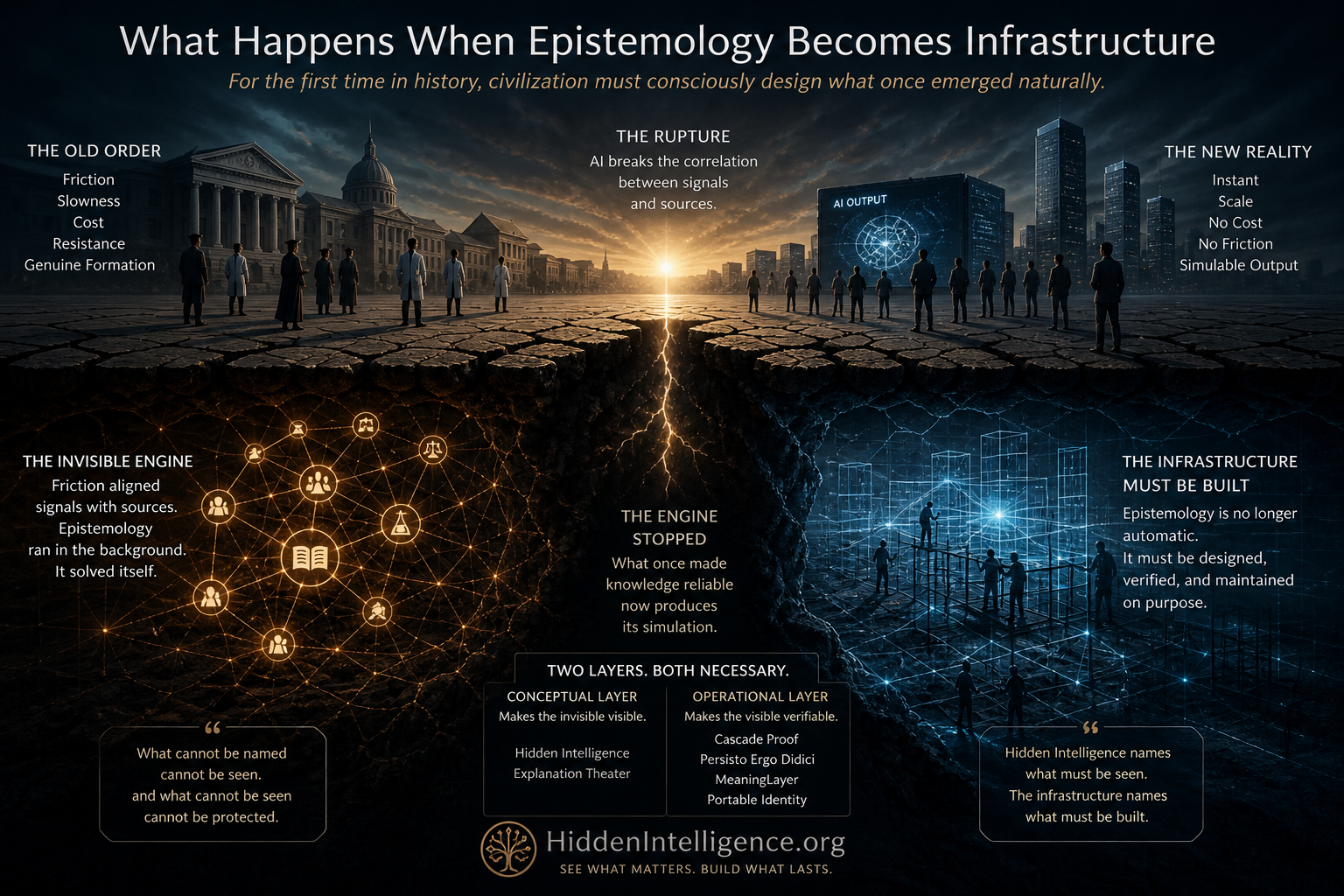
For the first time in history, civilization must consciously design what once emerged naturally
For most of human history, nobody had to think about epistemology. That was precisely what made it work.
The Background Process Nobody Noticed
Epistemology — the study of how we know what we know, what counts as knowledge, and how understanding is distinguished from its absence — has been a philosophical discipline for more than two thousand years. Plato examined it. Descartes rebuilt it. Hume destabilized it. Kant reconstructed it. Generations of philosophers have argued about its foundations, its limits, and its implications.
The old epistemological order assumed that thinking behavior reliably indicated a thinking being. AI broke that assumption. That is why epistemology can no longer remain background philosophy — it must become designed infrastructure.
But for most of human history, these arguments remained academic in the truest sense. The practical question of how civilization actually distinguished genuine knowledge from its absence, genuine expertise from its performance, genuine understanding from confident confusion — this was never a design problem. It solved itself.
Not because the problem did not exist. But because the conditions of human knowledge production — its slowness, its friction, its resistance, its cost — enforced a natural epistemological order that no institution needed to formalize and no philosopher needed to specify.
Knowledge was slow to produce. It required genuine encounter with genuine difficulty. It could not be generated faster than human minds could process, integrate, and reconstruct it. This meant that the signals of genuine understanding — the ability to navigate novel situations, to recognize when an established approach was failing, to reason from structural principles rather than pattern-matching to familiar cases — moved at roughly the same pace as genuine understanding itself. You could not convincingly perform knowledge you did not possess across every context that performance might be tested in.
The friction was epistemology’s enforcement mechanism. And it operated invisibly, automatically, without anyone needing to design it.
How Friction Regulated Everything
Consider how professional formation worked before the friction was removed.
A physician developing genuine clinical judgment did not acquire it through explanation alone. She acquired it through thousands of encounters with patients whose presentations resisted the established patterns — through failure and reconstruction, through the specific experience of being wrong in ways that mattered and having to understand why. The clinical judgment that resulted was not a collection of rules. It was a cognitive architecture — a perceptual structure that allowed her to recognize what was atypical before she could articulate why, to generate differential diagnoses appropriate to genuinely novel presentations, to know when the standard approach was insufficient.
This architecture could not be borrowed. It could not be performed. It could only be built through the specific process of genuine encounter with genuine difficulty over extended time. And because it could only be built that way, the signals that indicated its presence — the pattern recognition, the judgment, the navigational capacity — reliably correlated with the thing they indicated. The physician who demonstrated genuine clinical judgment generally possessed the architecture that made it possible.
The same was true across every domain where genuine expertise mattered. Legal reasoning. Engineering judgment. Scientific understanding. Pedagogical insight. In each case, the friction of genuine formation — the time, the difficulty, the failure, the reconstruction — was the mechanism that kept signals and sources aligned.
Institutions did not design this alignment. They inherited it. Credentials, examinations, apprenticeships, professional licensing — these systems were built on the assumption that the friction existed, that producing the signals of genuine expertise required possessing the formation that genuine expertise demands. They measured proxies because proxies worked. Not perfectly — there were always gaps between what credentials certified and what practitioners actually possessed. But reliably enough that civilization could build functional systems for identifying, developing, and deploying human capability.
Epistemology was the background process. Friction was its engine. And the engine ran without anyone flipping a switch.
The First Time in History
Then the engine stopped.
Epistemology did not become complicated. It stopped working on its own.
What once made knowledge reliable now produces its simulation.
Not gradually. Not partially. The friction that once enforced the correlation between signals and sources was removed simultaneously across every domain where AI assistance became available.
This is the civilizational rupture that has no historical precedent.
Every previous technological transformation changed what humans could do while leaving the epistemological order intact. Writing extended memory without replacing the formation process that built genuine understanding. The printing press accelerated knowledge distribution without separating the ability to produce sophisticated output from the understanding that sophisticated output once required. Even the internet — which made information instantaneously available at scale — did not break the correlation between demonstrating expertise and possessing it, because producing original sophisticated reasoning still required the architecture that genuine formation builds.
AI broke this correlation. For the first time in history, the outputs of genuine understanding — coherent analysis, sophisticated reasoning, structured argument, professional judgment — became producible without the formation process that once made them possible. The signals survived the separation from their sources. And with that separation, the friction that had always regulated the epistemological order disappeared.
When friction disappeared, epistemology stopped being background and became infrastructure — something civilization must now design on purpose or lose by default.
This is new. Not in degree but in kind. Previous civilizations never faced the condition in which the signals of genuine knowledge could be generated at scale, instantly, without cost, by systems that possessed no understanding of what they were generating. The philosophical problems were always there. The practical problem — the problem of civilization needing to actively design what once emerged naturally — is happening now, for the first time, in our lifetimes.
For the first time in history, civilization must consciously design the very conditions that once emerged naturally.
What Epistemology as Infrastructure Actually Means
When we say epistemology has become infrastructure, we mean something precise.
Infrastructure is what a system depends on without being able to function without it — what must be deliberately designed, maintained, and protected because it no longer sustains itself. Roads do not appear because people want to travel. Water systems do not emerge because people are thirsty. These things exist because civilization made the deliberate decision to build and maintain them, because the conditions under which they once emerged naturally — small-scale communities, local knowledge, informal coordination — no longer apply at civilizational scale.
Epistemological infrastructure is the same category of problem. The conditions under which the epistemological order once sustained itself — friction, slowness, cost, the natural alignment of signals with sources — no longer apply in a world where AI assistance is universally available. The order will not sustain itself. It must be built.
AI did not accelerate knowledge. It accelerated the collapse of the assumptions that once made knowledge self-stabilizing.
Epistemology is not yet infrastructure. That is the problem. It is becoming infrastructure for the first time in history — because reality no longer maintains it.
This is not a philosophical project. It is a design project. And like all infrastructure projects, it requires two things that philosophy alone cannot provide: a language precise enough to specify what needs to be built, and operational systems capable of building it.
Two Layers — And Why Both Are Necessary
This is where the distinction that most discussions of AI and knowledge miss becomes critical.
There are two fundamentally different kinds of work required to address the epistemological infrastructure problem. Conflating them produces confusion about what is possible, what is needed, and what different projects are actually doing.
The first layer is conceptual. Before anything can be measured, verified, or protected, it must be seen. And before it can be seen, it must be named with enough precision that the naming creates genuine perceptual capacity — the ability to notice something that was previously invisible, to ask questions that could not previously be formulated, to recognize a class of phenomena that had no prior designation.
Hidden Intelligence is this kind of work. It does not implement anything. It does not verify anything. It does not produce a protocol or a standard or a measurement system. What it does is make a specific phenomenon visible — the dimension of human intelligence that operates through transformation rather than production, that lives in what continues operating in others rather than in what was produced in the moment.
Before this name, the phenomenon existed. Educators who changed how students see rather than merely what students know existed. Leaders whose presence built capability that persisted after they moved on existed. Practitioners whose judgment continued operating in the decisions of those they formed existed. But the phenomenon had no precise designation — which meant it could not be systematically recognized, designed for, rewarded, or protected. It could be felt as a gap between what gets measured and what matters. It could not be specified as a target.
Explanation Theater is the same kind of work. It names the condition in which correct, coherent explanations are produced without the structural comprehension required to generate them independently — making visible a phenomenon that was always present but never precisely designated.
Concepts let us see the world. Infrastructure lets us act on what we see. And without both, perception becomes paralysis.
Lenses change perception. Infrastructure changes civilization’s behavior. Both are necessary. Neither is the other.
The second layer is operational. Once the phenomenon is visible and named, the question becomes: how do we verify its presence or absence? How do we build systems that can distinguish genuine formation from its performance? How do we create standards that institutions can implement, credentials that certify what they claim to certify, verification mechanisms that survive in a world where every behavioral signal can be perfectly replicated?
This is the domain of Cascade Proof, Persisto Ergo Didici, MeaningLayer, and Portable Identity. These are not concepts that make something visible. They are systems that make something verifiable and actionable.
Cascade Proof does not explain what genuine intelligence is. It provides the cryptographic verification standard through which genuine capability transfer — the cascade of understanding that moves through human networks independently and exponentially — can be distinguished from dependency chains that collapse when assistance is removed. It solves the problem of proving causation when observation alone has failed.
Without this, capability cannot be distinguished from its performance.
Persisto Ergo Didici does not explain what genuine learning is. It provides the temporal verification protocol through which genuine capability development — formation that persists independently when assistance is removed and time has passed — can be distinguished from performance that disappears when the conditions that produced it change.
Without this, learning cannot be distinguished from its appearance.
MeaningLayer does not explain what genuine understanding is. It provides the semantic infrastructure through which genuine capability transfer can be classified, tracked, and distinguished across different domains and contexts.
Without this, improvement cannot be distinguished from optimization.
Hidden Intelligence is the lens. Cascade Proof is the lock — one reveals what matters, the other protects it.
Neither layer is sufficient alone. The conceptual layer without the operational layer produces accurate diagnosis without the ability to act on it — civilization can see what is missing but has no mechanism to verify its presence when found or to protect it when identified. The operational layer without the conceptual layer produces measurement infrastructure without knowing what to measure — systems that can verify something without being clear on what that something is or why it matters.
Both layers are necessary. They are different in kind. And understanding the difference is itself a form of epistemological clarity that the infrastructure problem requires.
What Is at Stake If the Infrastructure Is Not Built
The consequences of not building epistemological infrastructure are not dramatic. That is what makes them dangerous.
They arrive as normal institutional operation. Credentials continue to be issued. Assessments continue to be conducted. Hiring decisions continue to be made. AI systems continue to be deployed. Nothing announces itself as failure. The metrics continue to look normal. The processes continue to function as designed.
What changes, invisibly and cumulatively, is the relationship between what these processes certify and what actually exists behind the certifications.
Educational systems that cannot distinguish genuine formation from AI-assisted performance will graduate populations with credentials that certify what was produced rather than what was built. The graduates will function adequately in familiar conditions with assistance available. The conditions under which genuine structural understanding is required — genuinely novel situations, problems that fall outside the patterns, moments when the established approach fails and reasoning from first principles is necessary — will reveal the gap.
Organizations that cannot identify the people who build genuine capability in others will systematically misallocate the most important resource they possess. They will optimize for visibility, speed, and output volume — which AI can increasingly provide more efficiently than humans — while overlooking the people whose presence changes how everyone around them thinks. The result is not immediate catastrophe. It is the gradual erosion of the organizational capacity to navigate genuine novelty, which only becomes visible when genuine novelty arrives and the organization discovers it has been selecting against the capability it most needed.
Democratic institutions that cannot distinguish genuine expertise from its performance will lose the capacity to evaluate the people who claim authority on the basis of that expertise. The epistemological collapse is simultaneously a political one — not through explicit power seizure, but through the quiet erosion of the conditions under which genuine collective judgment is possible.
These are not hypothetical futures. They are the structural consequences of operating measurement systems calibrated for a world that no longer exists. The systems will not self-correct. They are designed to measure what they measure. If what they measure no longer indicates what it was supposed to indicate, the systems will continue to produce readings — confident, institutionally validated readings — that certify the wrong thing.
The infrastructure must be built deliberately. It will not build itself.
Where Hidden Intelligence Fits
Hidden Intelligence is not the infrastructure. That distinction matters and must be held precisely.
Hidden Intelligence is the perceptual layer — the conceptual lens that makes a specific phenomenon visible for the first time with enough precision to act on. It names the dimension of human capability that the collapse of epistemological self-regulation has made both most invisible and most important: the intelligence that operates through transformation rather than production, that lives in what continues operating in others, that can only be verified through its effects over time.
Without this lens, the infrastructure cannot be built — because the builders cannot see what they are building for. You cannot design verification systems for a phenomenon you cannot name. You cannot protect what you cannot perceive. You cannot demand what you cannot specify.
With this lens, the infrastructure becomes buildable. The verification questions become askable: not ”what did this person produce?” but ”what continues operating in others because of genuine encounter with this person’s understanding?” Not ”does this output meet the standard?” but ”does the architecture that produced this output persist, generalize, and propagate when conditions change?” Not ”is this AI system helpful?” but ”does interaction with this system build genuine capability that persists independently — or does it create dependency that performs as capability until the moment it is tested?”
These questions could not be asked systematically before the name existed. They can be asked now. And asked questions, eventually, get answered — in the form of standards, verification mechanisms, institutional practices, and measurement systems designed to detect what currently goes undetected.
The epistemological infrastructure of the AI era is not yet built. The conditions that made it unnecessary no longer exist. The conditions that make it necessary are already here.
Hidden Intelligence is the beginning of building it — not as infrastructure itself, but as the lens through which the need for infrastructure becomes impossible to mistake for anything else.
The Canonical Statement
Epistemology was civilization’s background process. Friction was its engine. AI removed the engine. What was once automatic must now be built.
What cannot be named cannot be seen, and what cannot be seen cannot be protected.
Hidden Intelligence names what must be seen. The infrastructure names what must be built. Both are necessary. Neither is sufficient alone.
→ The Framework — The structural model of Hidden Intelligence as a system → CascadeProof.org — The verification standard → PersistoErgoDidici.org — The temporal learning verification protocol → MeaningLayer.org — The semantic infrastructure
2026-05-02