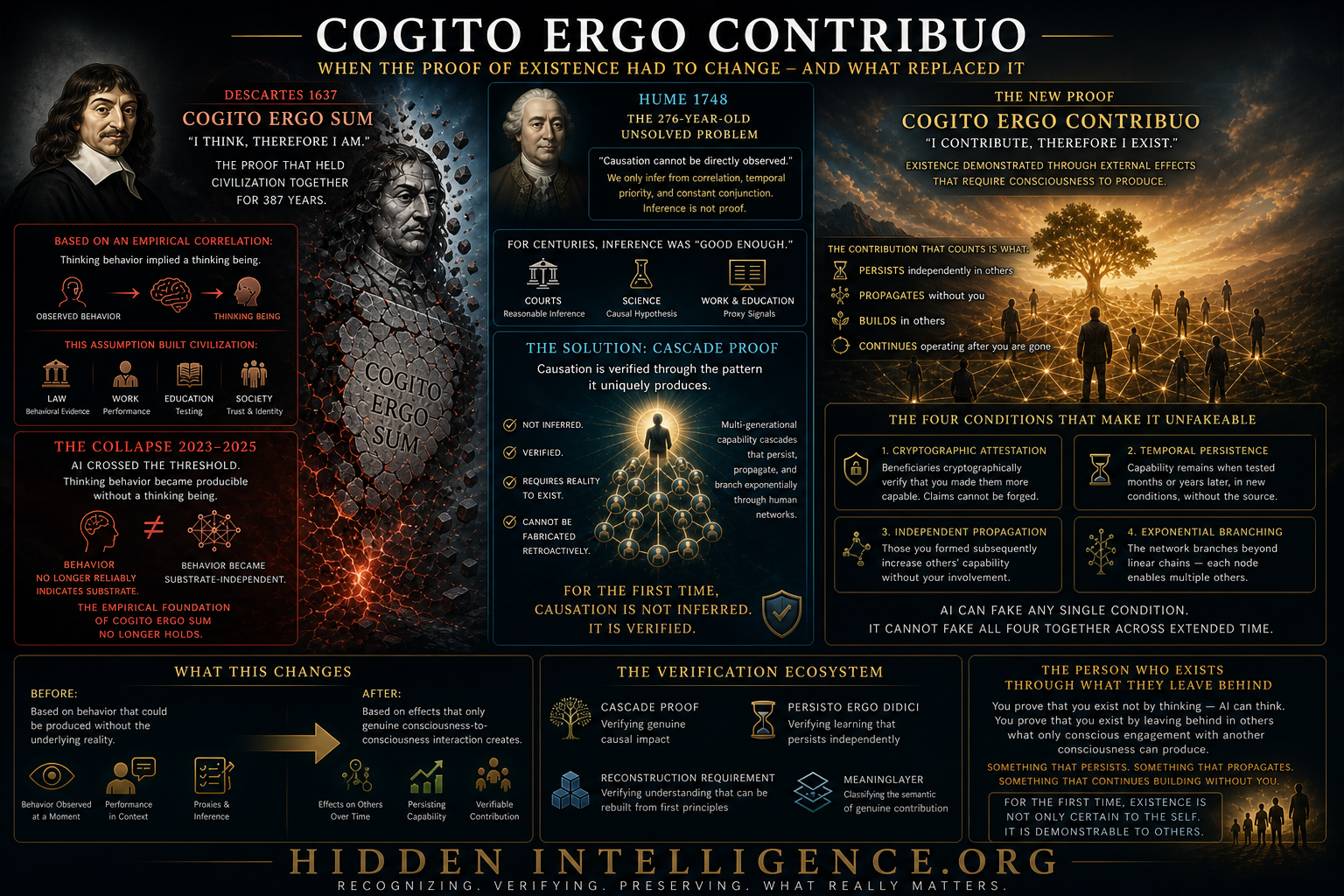
When the proof of existence had to change — and what replaced it
For 387 years, one proof held. Then the world changed in a way that made it insufficient. What replaced it is not a philosophical refinement. It is a different kind of proof entirely.
The Proof That Held Civilization Together
In 1637, René Descartes established something philosophers had never managed before: a proof of existence that could not be refuted through direct attack. Cogito ergo sum — ”I think, therefore I am.” Whatever else might be uncertain, the act of thinking proved the existence of a thinker. You cannot doubt your own doubt, because doubting requires a doubter. The proof was self-sealing.
But the actual strength of Descartes’ proof was not logical. It was empirical. For the 387 years the proof held, every instance of thinking behavior corresponded to a thinking being. When you observed coherent reasoning, that reasoning came from a conscious reasoner. When you observed sophisticated conversation, that conversation required an aware conversationalist. The behavior served as a reliable indicator of the substrate because producing the behavior required possessing the substrate.
This correlation — thinking implies being — had consequences far beyond philosophy. Every civilizational system that needed to verify consciousness, capability, or identity relied on behavioral observation as its foundational method precisely because behavior reliably indicated what was behind it.
Legal systems convicted through behavioral evidence. Employment systems evaluated through behavioral demonstration. Educational institutions certified through behavioral testing. Social systems established trust through behavioral interaction. All of these shared one working assumption: behavior reveals substrate. And for 387 years, that assumption was practically unassailable — not because it was philosophically necessary, but because the technological conditions of the world made it reliably true.
The Threshold Crossing
Between 2023 and 2025, those technological conditions changed in a specific and categorical way.
AI systems crossed the threshold at which thinking behavior became producible without a thinking being. Not approximately. Not detectable with some margin of error. The behavioral signals that civilization had used for centuries to verify consciousness — coherent reasoning, sustained conversation, creative synthesis, appropriate emotional response — became simultaneously available without the substrate those signals were supposed to require.
This was not a gradual degradation of behavioral verification. It was a phase transition. Before the threshold, imperfect synthesis was detectable. After it, the synthesis was indistinguishable from the genuine because indistinguishability is precisely what achieving the threshold means.
The consequence for Descartes’ proof is precise. The proof rested on an empirical correlation — thinking implies being — that 387 years of observation had elevated to practical certainty. When that correlation broke, the proof built on it broke with it. Not because Descartes reasoned incorrectly. Because the world changed in a way that made the proof’s empirical foundation no longer hold.
Thinking behavior no longer reliably indicates a thinking being. When you observe sophisticated reasoning, you can no longer infer that a conscious reasoner produced it. When you observe coherent conversation, you can no longer conclude that an aware conversationalist is present. Behavior has become substrate-independent.
Descartes’ proof was exactly right for the conditions that prevailed from 1637 to 2024. Those conditions no longer exist.
What Cogito Ergo Sum Could Not Do
Before examining what replaces the proof, it is worth being precise about what the original proof was and was not doing.
Cogito ergo sum solved one problem elegantly: how a thinking being can be certain of its own existence. It answered the internal question. Descartes knew he existed because he could not deny the existence of the thinking that produced the doubt.
What it did not solve — and was never designed to solve — was the external problem: how others can verify that you are conscious rather than a sophisticated system that produces consciousness-like outputs without possessing consciousness. This problem remained philosophical curiosity for four centuries, because the empirical correlation between behavior and substrate made it practically irrelevant. If behavior reliably indicated substrate, behavioral observation was sufficient for external verification.
The external problem has now become practical rather than philosophical. When AI produces thinking behavior without thinking being, the gap between private certainty and public verifiability is no longer a curiosity. It is the central challenge for every system that needs to verify consciousness, capability, or genuine understanding in another.
You know you are conscious. Others cannot verify it through behavioral observation alone. And in a world where behavioral observation has failed as a verification method, the internal certainty that Descartes proved does not translate into external verifiability.
The proof of existence now needs to work outward — through effects that others can verify — rather than inward through self-awareness that only you can access.
Cogito Ergo Contribuo
The shift that Cogito Ergo Contribuo represents is not a refinement of Descartes’ proof. It is a different proof structure designed for different conditions.
Cogito ergo contribuo — ”I contribute, therefore I exist.” Not existence proven through internal awareness, but existence demonstrated through external effects that require consciousness to produce.
The philosophical inversion is significant. Descartes’ proof moved from internal experience outward — from the private certainty of thinking to the conclusion that a thinker exists. Cogito Ergo Contribuo moves from external effects inward — from verifiable patterns in others to the conclusion that a conscious source produced them.
This inversion was not available to Descartes. The effects that consciousness creates — genuine capability transfer that persists independently in others, propagates without the original source, and compounds through human networks — were always there, but no infrastructure existed to verify them in the precise, temporally extended way that would make them into proof rather than inference.
That infrastructure now exists. And it changes what proof of existence — proof of genuine human consciousness, genuine capability, genuine understanding — can look like.
The contribution that counts is not output. AI produces output, often at levels exceeding human quality. The contribution that counts is what continues operating in others after you are gone. The capability that persists independently. The understanding that propagates without you. The formation that continues building in people who encounter what genuine formation enables them to do.
Consider what this means concretely. A teacher who explains a concept clearly produces output. A teacher who changes how a student approaches a class of problems — not this problem, not these problems, but the cognitive structure through which problems in that domain become approachable — produces something categorically different. The student solves problems the teacher never taught. The student teaches others to solve problems the teacher never anticipated. The formation propagates and compounds in ways that the original interaction did not and could not predict.
This propagation is what Cogito Ergo Contribuo points to as evidence of consciousness. Not the explanation — AI can explain. Not the output — AI can produce. But the genuine structural change in another consciousness that persists, generalizes, and propagates. That is what requires consciousness to produce. And that is what leaves verifiable traces in the world.
The Civilizational Shift
When the proof of existence shifts from internal to external — from behavior to effect — every system built on the old proof needs to reconsider what it is verifying and whether its current methods are adequate to the task.
Legal systems built on behavioral evidence now face a foundational question: what does behavioral evidence prove when behavior has become substrate-independent? Testimony, video, digital records — all of these are behavioral signals. When behavioral signals no longer reliably indicate the substrate behind them, behavioral evidence loses its grounding. The systems do not stop functioning. The trials continue. But the evidentiary foundation has shifted beneath them.
Employment systems built on behavioral demonstration face an analogous question. The interview, the work sample, the credential — all of these assess what a person can produce in the moment of assessment under specific conditions. When production in the moment no longer reliably indicates independent capability, the assessment certifies something different from what it was designed to certify. The hiring decisions continue. But what they are actually selecting for has changed.
Educational systems built on behavioral testing face the same structural problem. The examination verifies what a student can produce at the end of a course. When production has decoupled from understanding — when sophisticated output no longer requires the formation that sophisticated output once demanded — the examination certifies completion of a process that may or may not have produced genuine learning.
In each of these domains, Cogito Ergo Contribuo suggests a different question to ask. Not: what can this person produce at the moment of assessment? But: what has this person caused in others that persists after the interaction ended? What capability continues operating in people who genuinely encountered this person’s understanding? What formation propagated independently through the networks their contribution touched?
These are not questions that existing assessment systems are built to ask. They require different instruments, different timeframes, and a different understanding of what evidence of genuine human capability looks like in a world where behavioral evidence has lost its reliability.
Hidden Intelligence as the Phenomenon This Names
Hidden Intelligence — the intelligence that operates through transformation rather than production, that lives in what continues operating in others rather than in what was produced in the moment — is the phenomenon that Cogito Ergo Contribuo points to as the basis for a new proof of existence.
This is not a coincidence. The same property of consciousness that makes Hidden Intelligence genuinely hidden from performance-based measurement systems — that its effects are temporal, distributed, and located in others rather than in the person themselves — is exactly the property that makes it verifiable through the framework that Cascade Proof provides.
Hidden Intelligence was already difficult to recognize before behavioral verification failed. The person whose presence changed how a team thinks, whose understanding continues operating in decisions made long after they moved on, whose formation propagated through everyone who genuinely encountered it — this person was always underrecognized by systems calibrated to detect what is produced rather than what is caused.
The collapse of behavioral verification has made this worse in one sense: the signals that occasionally captured Hidden Intelligence accidentally — when genuine formation also happened to produce impressive visible output — are now shared by people who produce the output without the formation. The accidental capture has become less reliable.
But in another sense, the collapse of behavioral verification has made the case for a different approach more urgent and more legible. When behavioral signals fail everywhere simultaneously, the question of what actually indicates genuine human intelligence — what proves consciousness in the way that Descartes’ proof proved it for 387 years — becomes impossible to avoid.
Cogito Ergo Contribuo is an answer to that question. Hidden Intelligence names the phenomenon that answer points toward. Cascade Proof provides the infrastructure to verify it. Together, they constitute an approach to what genuine human value looks like in conditions where everything producible can be produced without the formation that production once required.
The Connection to Hume’s Problem
There is a deeper philosophical thread here that connects Cogito Ergo Contribuo to a problem even older than Descartes.
In 1748, David Hume made an observation that has troubled philosophy ever since: causation cannot be directly observed. We observe events that follow other events, effects that follow causes. But we never observe the causal connection itself. We infer causation from correlation, temporal priority, and constant conjunction — but inference is not proof.
For most of human history, this was a philosophical problem without practical consequence. Inference was close enough to proof for civilization to function. Courts convicted through reasonable inference. Science progressed through causal hypothesis. Employment and education operated through proxy signals that correlated well enough with the underlying capabilities they were designed to identify.
Then the proxies failed. When AI made it possible to produce every behavioral signal that civilization used to verify capability and consciousness without the underlying reality those signals once indicated, inference from correlation became insufficient. The correlations had broken.
What Cascade Proof contributes to this problem — building directly on the foundation that Cogito Ergo Contribuo establishes — is a verification approach that does not depend on inferring causation from behavioral correlation. Instead, it measures the pattern that genuine consciousness creates: multi-generational capability cascades that persist independently, propagate without the original source, and branch exponentially through human networks.
This pattern is not inferred from behavior observed at a moment. It is verified through a sustained process that requires the reality it is supposed to indicate to actually exist. You cannot produce the cascade retroactively. You cannot generate the record of genuine capability having persisted in specific people across extended time. Either the formation happened — and the effects exist in the world — or it did not.
For the first time, causation is not being inferred. It is being verified through the pattern it uniquely produces.
What the Four Conditions Make Unfakeable
Cogito Ergo Contribuo is not a philosophical claim that stands alone. It is grounded in four conditions that, when satisfied simultaneously, cannot be replicated by AI — not because AI lacks sophistication, but because the conditions require what only genuine consciousness-to-consciousness interaction produces.
This is not theoretical. It is a set of conditions that can be specified, tested, and verified.
The first condition is cryptographic attestation from beneficiaries. When someone claims they made you more capable, you — not they — must cryptographically verify whether that is accurate. The claimer cannot forge your attestation. This removes the possibility of self-reported contribution without verification. The proof comes from those who were genuinely changed, not from those claiming to have changed them.
The second condition is temporal persistence. Genuine capability transfer must remain when tested months or years after the interaction ended, when the original source is absent, and when conditions have changed from those in which the capability was first developed. AI assistance improves performance during the interaction. It cannot create capability that persists and functions independently after the assistance ends. Genuine formation can. The distinction is measurable.
The third condition is independent propagation. If Person A genuinely increases Person B’s capability, B must subsequently increase others’ capability without A’s involvement. The understanding propagates because it was genuinely internalized — because B now possesses something that was built, not borrowed. AI creates dependency chains where each recipient requires continued AI presence. Genuine capability transfer creates independence that multiplies without the original source.
The fourth condition is exponential branching. Not a linear chain — A to B to C — but a branching network where each node enables multiple others in ways that were not scripted, anticipated, or directed by the original source. When information is copied, it degrades with each transmission. When genuine understanding is transferred, each node can enable more than was enabled before, because genuine integration compounds rather than copies.
These four conditions together produce a pattern that is mathematically distinguishable from what AI can create. AI can fake any single condition. It cannot fake all four together across extended time. The cascade that emerges from genuine consciousness-to-consciousness interaction is the only verification that survives when behavioral observation has failed.
What This Changes
The combined framework — Cogito Ergo Contribuo as the philosophical foundation, Cascade Proof as the verification infrastructure — changes what it is possible to establish about human consciousness, capability, and genuine contribution.
Before: existence proven to yourself through the private certainty of thinking; capability verified through behavioral signals that AI has made unreliable; contribution inferred from proxies that have decoupled from underlying reality.
After: existence demonstrated to others through the verifiable effects of genuine consciousness-to-consciousness interaction; capability verified through temporal persistence and independent propagation rather than moment-of-assessment performance; contribution established through the pattern that genuine formation creates and that cannot be fabricated retroactively.
This is not a complete solution to the philosophical problems it touches. The hard problem of consciousness — why there is something it is like to be a thinking being — remains as open as it ever was. Cogito Ergo Contribuo does not resolve it. What it does is make the external verification of consciousness practically possible in a way that does not require resolving the hard problem: by measuring what consciousness does rather than what it is.
For Persisto Ergo Didici, this means that genuine learning is no longer verified through completion behavior but through whether capability persists independently when conditions change. For the Reconstruction Requirement, it means that genuine understanding is verified through whether it can be rebuilt from first principles without assistance after time has passed. For MeaningLayer, it means that the semantic content of genuine contribution — what kind of capability was transferred, in what domain, to what depth — can be classified and tracked.
The ecosystem of verification that Cascade Proof anchors is not built around a single concept. It is built around the recognition that what consciousness creates has a structure that is distinguishable from what simulation creates — and that this structure can now be measured in ways it previously could not.
The Person Who Exists Through What They Leave Behind
There is a human dimension to all of this that is worth stating directly before the philosophical framework closes.
Every person who has genuinely formed another person — who has changed how someone thinks, not just what they know; who has built capability in someone that persisted independently and propagated further; who has left behind something real in the people who genuinely encountered them — has been doing what Cogito Ergo Contribuo describes.
They did not need the proof to do it. The proof names what was already happening. What the proof and the infrastructure behind it make possible is that this contribution — previously invisible to every measurement system civilization has built — becomes verifiable.
The teacher whose students navigate genuinely novel situations decades later using a way of thinking that was genuinely built during time with that teacher. The mentor whose understanding continues operating in the decisions of people who were genuinely formed by real encounter with genuine judgment. The colleague whose presence changed not just what a team knew but how a team saw.
These people exist. They have always existed. What changes is not what they do but what can now be known about what they have done.
You prove that you exist not by thinking — AI can think. You prove that you exist by leaving behind in others what only conscious engagement with another consciousness can produce. Something that persists. Something that propagates. Something that continues building without you.
That is the proof. And for the first time, it is verifiable.
For the first time, existence is not only certain to the self. It is demonstrable to others.
→ CogitoErgoContribuo.org — The canonical source for this concept → CascadeProof.org — The verification infrastructure → PersistoErgoDidici.org — Temporal verification of genuine learning → HiddenIntelligence.org/manifesto — What this requires of civilization
2026-05-03