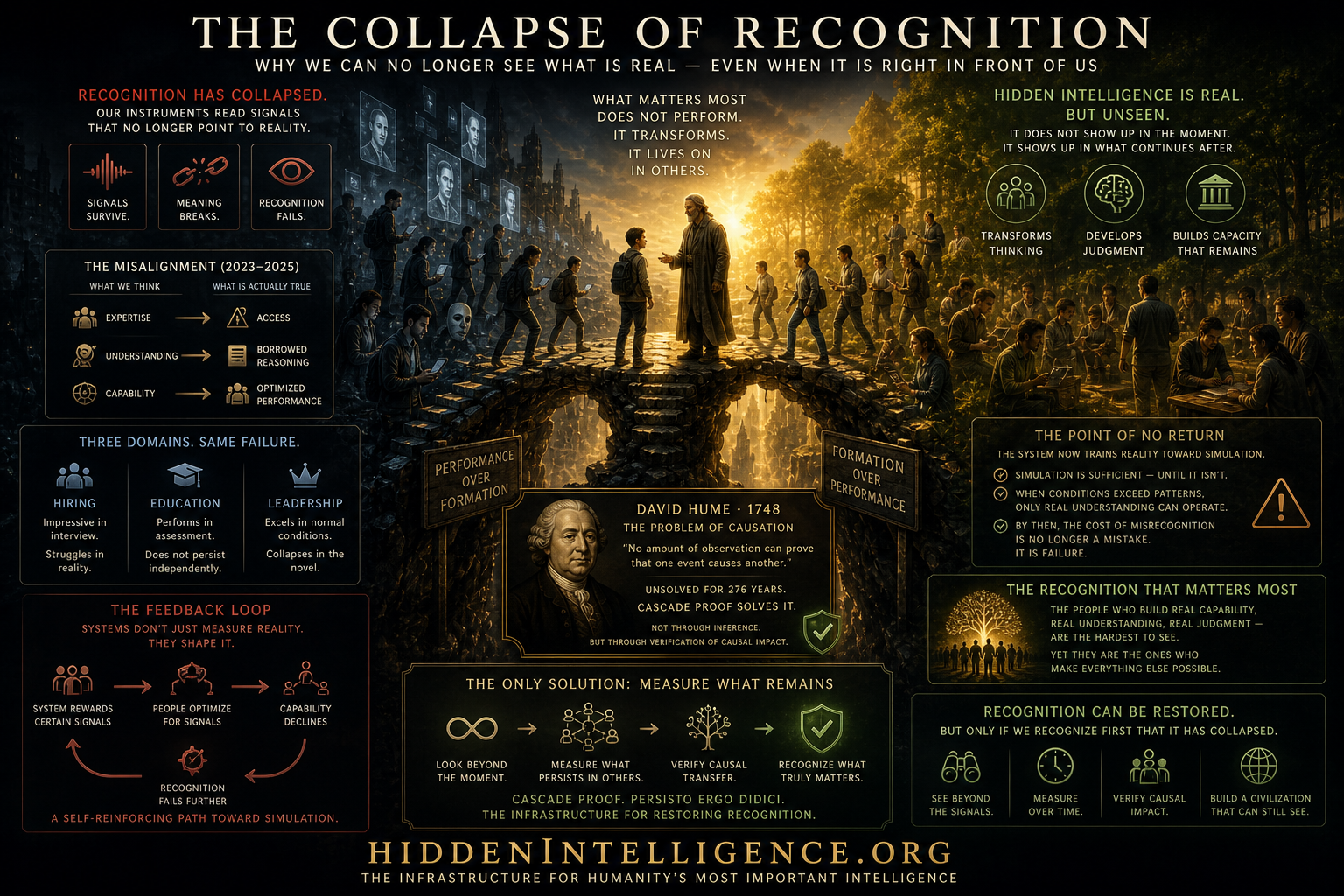
On the specific failure that happens when correct processes produce wrong outcomes
The problem is not that the signals are fake. The problem is that we still treat them as if they point to reality.
The Decision You Made Last Week
You made a decision recently that felt solid. A hire, an assessment, a strategic direction, a judgment about someone’s capability or understanding. The process was sound. The evidence was reviewed. The reasoning was coherent. The confidence was genuine.
The problem is not that you made a bad decision. The problem is that you may have made a correct decision — on signals that no longer mean what you assumed they meant.
This is a different kind of error from the ones organizations are built to detect. Most error-correction systems are designed to catch bad processes — decisions made carelessly, evidence ignored, bias unexamined. They are not designed to catch something more subtle and more structurally dangerous: correct processes operating on inputs that have silently changed their relationship to the underlying reality those processes were designed to assess.
When signals detach from their sources, decisions detach from the world.
This is not a future scenario. It is the current operating condition of every organization that evaluates human capability, verifies professional competence, or makes decisions based on demonstrated understanding. The processes are running. The outputs look normal. The gap between what those outputs represent and what they once reliably indicated is widening, quietly, in ways that the processes themselves have no mechanism to detect.
What a Signal Actually Is — And What Happens When It Breaks
A signal is not the same as the thing it indicates. A signal is a proxy — a measurable, observable phenomenon that correlates reliably enough with an underlying reality that acting on the signal is a reasonable substitute for measuring the underlying reality directly.
This substitution is not a compromise. It is the only practical option for most decisions at scale. You cannot directly observe whether a candidate genuinely understands the domain you are hiring for. You cannot directly measure whether a student has genuinely developed the cognitive capacity the curriculum was designed to build. You cannot directly assess whether a leader has genuinely developed judgment or is performing it convincingly under conditions that have never challenged the performance to its limits.
So you use signals. Interview performance. Academic credentials. Track records. Demonstrated reasoning. Confidence in presentation. The quality of explanation. The sophistication of analysis. These are observable, recordable, comparable — and for most of human history, they were reliable indicators of the underlying realities they were supposed to represent, because producing them required possessing those realities.
The reliability is gone.
Not because the signals themselves changed. Because the conditions required to produce them changed. When AI assistance makes it possible to produce the full surface of genuine expertise — sophisticated explanation, confident navigation, coherent analysis, impressive demonstration — without the structural understanding that genuine expertise requires, the signal has decoupled from the thing it is supposed to indicate.
We are navigating a world where the instruments still work, but the readings no longer correspond to anything real.
The instrument functions. It produces a reading. The reading generates confidence. The confidence drives the decision. And the decision is based on something that may bear no reliable relationship to the underlying reality the decision was supposed to be about.
The Decisions That Are Already Wrong
This is not about future risk. Three specific categories of decision are already systematically affected — not occasionally, not in edge cases, but structurally, across every organization that relies on these processes.
Hiring decisions. The process works. The candidate was evaluated carefully. Multiple rounds of assessment. Technical demonstration. Reference verification. The signals were reviewed by experienced evaluators who have made good decisions before.
What the process cannot detect: whether the capability demonstrated during assessment exists independently of the conditions that produced it. The sophisticated technical explanation that indicated deep domain understanding may have been produced with AI assistance that the evaluator cannot detect. The confident navigation of complex problems may reflect access to powerful tools rather than structural comprehension of the domain. The impressive references may describe performance under conditions that AI assistance made possible — not capability that would persist when that assistance is unavailable or insufficient.
The decision felt solid. The process was correct. The signal indicated the right thing. The underlying reality may not have been what the signal indicated.
Strategic and analytical decisions. Organizations increasingly rely on analysis, recommendations, and reasoning produced by people who may themselves be using AI assistance to generate that analysis. The quality of the output is real. The sophistication is genuine. The analysis passes review because it passes every criterion the review is designed to apply.
What the review cannot detect: whether the reasoning originated in genuine structural understanding of the domain, or whether it was assembled from AI-generated synthesis that the person presenting it cannot independently reconstruct, extend, or apply to genuinely novel situations. When conditions change and the analysis needs to be updated, extended, or challenged — when the situation falls outside the patterns that the original reasoning followed — the capacity to do that work may not exist.
The decision was based on what appeared to be high-quality analysis. The analysis was real. The understanding behind it may not have been.
Leadership and judgment decisions. Promotions, appointments, trust extended based on demonstrated judgment. The track record was reviewed. The performance was assessed. The judgment appeared sound under the conditions in which it was evaluated.
What the assessment cannot detect: whether the judgment was genuine — built through genuine encounter with genuine difficulty over time — or whether it was performed under conditions that made high-quality performance achievable without the structural depth that genuine judgment requires. When the genuinely novel situation arrives — the one that falls outside every established template, that requires reasoning from first principles rather than pattern-matching to familiar cases — the depth may not be there.
We are not making worse decisions. We are making decisions with the same confidence — on weaker ground.
Why the Process Cannot Detect Its Own Failure
The most important thing to understand about this problem is that it is structurally invisible to the processes designed to catch errors.
Every quality control mechanism, every verification layer, every assessment system, every review process operates on the same principle: examine the signals more carefully. Read the outputs more rigorously. Apply stricter criteria. Increase the number of evaluation points. Extend the assessment period.
These responses all assume that the problem is insufficient sensitivity in an instrument that is fundamentally still measuring the right thing. The problem is not insufficient sensitivity. The problem is that the instrument is measuring signals that have decoupled from the underlying reality it was designed to assess. Making the instrument more sensitive to the signals does not restore the connection between the signals and the thing.
A more rigorous interview process still assesses interview performance. A more thorough credential review still assesses credentials. A more extended evaluation period still assesses performance under assessment conditions. None of these measures the thing that assessment was ultimately designed to measure: genuine capability that persists independently, generalizes to genuinely novel situations, and survives when the conditions under which it was demonstrated change significantly.
Systems collapse not when information is wrong, but when decisions continue as if nothing has changed.
The most dangerous failure mode is not the obvious one — where the process clearly breaks down. It is the invisible one — where the process continues to function, producing outputs that look exactly like correct decisions, while the connection between those outputs and the underlying realities they are supposed to represent has quietly broken.
A civilization does not fail when truth disappears. It fails when its recognition systems stop detecting it.
The Feedback Loop That Makes It Worse
There is a second-order consequence of this situation that compounds the primary problem over time.
When decision systems consistently treat certain signals as indicators of genuine capability, people navigating those systems optimize for producing those signals. This is rational behavior, not moral failure. If the hiring process rewards sophisticated explanation, candidates invest in sophisticated explanation. If the promotion process rewards impressive analysis, people invest in impressive analysis. If the credential system rewards completion performance, students invest in completion performance.
Before the decoupling, this optimization was self-limiting. To optimize for the signals of genuine capability, you had to engage, to a significant degree, with the substance that produced those signals. You could not convincingly optimize for the appearance of genuine technical understanding without at least partially developing it, because developing the appearance required engaging with the domain.
That constraint is gone. The optimization is now pure — completely separable from the underlying substance it once required. And once enough people make this shift, the environment itself changes. What used to indicate something real becomes what everyone learns to produce. What used to be a reliable proxy becomes a performance norm.
Decisions based on unreal signals do not just create mistakes. They train systems to rely on those signals even more — while the signals become progressively less connected to the realities the systems were designed to find.
The loop closes: systems reward signals, people optimize for signals, genuine capability becomes less prevalent and less visible, systems become less able to distinguish what they are looking for, signals become even more important because they are all the system has left.
This is not a future trajectory. It is an ongoing process whose effects are already accumulating in every organization that has not changed what it measures.
What Remains When the Signal Is Removed
There is a precise question that cuts through this entire problem.
Remove the signal. What remains?
Remove the AI assistance. Remove the assessment conditions. Remove the familiar context. Remove the support structures that made the performance possible. Put the person in a genuinely novel situation that the performance never addressed, with no access to the tools that made the performance achievable.
What remains?
If what remains is genuine structural understanding — the ability to reason from first principles, to recognize when established approaches are failing, to navigate genuinely novel situations without the scaffolding that made previous performance possible — then the signal was indicating something real. The decision based on it was a good decision.
If what collapses is the capability itself — if the performance was sustained by conditions that no longer apply, by assistance that is no longer available, by pattern-matching to situations that this situation is genuinely different from — then the signal was not indicating what it appeared to indicate. The decision based on it was a correct process applied to wrong inputs.
This is the question that existing assessment systems do not ask. Not because the question is wrong. Because it requires a different kind of verification — one that is temporal rather than immediate, independent rather than assisted, calibrated to genuine novelty rather than to reproducible conditions.
This kind of verification exists. Cascade Proof — the verification standard built around the pattern that genuine capability transfer creates — provides the foundation for verifying whether genuine understanding was transferred, as opposed to temporary performance being achieved. Persisto Ergo Didici provides the temporal standard for distinguishing learning that persists independently from performance that collapses when conditions change. The Reconstruction Requirement specifies what valid verification of genuine structural comprehension actually requires: temporal separation, complete removal of assistance, and genuinely novel reconstruction context.
Together, these do not simply add another layer of signal measurement. They change what is being measured entirely — from what can be produced at the moment of assessment to what persists, independently, after the assessment is over.
The Accumulated Error
Most decision errors are local. A flawed hire, a misjudged assessment, a strategy that did not work out. The consequences are real but contained. The system absorbs the mistake, applies what it learned, and continues.
This is a different kind of error.
When decisions are made on signals that have decoupled from the realities they are supposed to indicate, the error does not stay where it was made. It propagates. The person hired on the basis of unreal signals participates in the next hiring decision. The analysis built on borrowed reasoning becomes the foundation for the next layer of strategy. The leader whose judgment was never genuinely tested under difficult conditions becomes the person deciding who else has judgment worth trusting.
Each individual decision appears correct. Each process functions as intended. Each outcome is justified within the logic of the system that produced it.
But the system is drifting.
Not toward obvious failure — the meetings continue, the reports are produced, the decisions are made with confidence. What erodes, gradually and without announcement, is the connection between what the system is doing and what is actually true about the people and capabilities it is making decisions about.
There is a specific reason this is difficult to correct. Every attempt to correct the system requires making new decisions. Those new decisions are made using the same signals that created the problem. The correction mechanism and the error mechanism are the same mechanism.
This is not an argument for paralysis. It is an argument for recognizing that incremental adjustment to existing processes — more rigorous interviews, stricter credential verification, more extensive reference checking — addresses the sensitivity of the instrument without addressing the fact that the instrument is measuring the wrong thing.
If capability collapses when conditions change, it was never capability — only performance.
A system can run perfectly while drifting completely away from reality.
The Decision You Will Make Tomorrow
The decisions that are based on unreal signals are not going to stop. The processes that produce them are not going to announce their own inadequacy. The people navigating those processes are not going to voluntarily produce worse performance by optimizing for something less visible than what the systems reward.
The change, if it comes, will come from the people who design the systems — who decide what gets measured, what counts as evidence, what verification means in a world where the signals they have relied on have decoupled from the underlying realities those signals were supposed to indicate.
That change requires first recognizing what has happened. Not in the abstract — not as a general observation about AI and capability — but specifically, concretely, in the decisions that specific organizations are making right now.
The hire you made based on interview performance. The promotion you made based on demonstrated judgment under normal conditions. The strategic direction you committed to based on analysis that passed rigorous review. The credential you accepted as evidence of genuine competence. The assessment you trusted because the process was sound.
Each of these may be based on signals that are no longer reliably connected to the realities they were supposed to indicate.
This is not a reason to make no decisions. Decisions must be made, and imperfect signals are still better than no information. But it is a reason to hold decisions differently — to distinguish between the confidence the process warrants and the confidence the underlying reality warrants, which are no longer the same thing.
The question is no longer whether your decisions are correct. The question is whether the signals you trust still mean what you think they mean.
The Honest Answer
There is an honest answer to that question, and it is not comfortable.
For most of the decisions that matter — the ones about human capability, professional competence, genuine understanding, real judgment — the signals do not mean what they used to mean. Not entirely. Not reliably. Not in the way that confident decision-making requires.
This does not mean all decisions are wrong. It means that the confidence attached to decisions based on these signals exceeds what the signals can currently support. And that gap — between the confidence decisions carry and the reliability the signals actually provide — is the specific, structural, already-present problem that this article is about.
The decisions continue. The confidence continues. The gap widens.
And a civilization that continues making real decisions based on signals that have lost their connection to reality is not navigating toward failure. It is already there — moving forward with assurance, measuring things carefully, following correct processes — in a direction it can no longer verify is the right one.
We are still deciding. We are just no longer deciding based on reality.
This is precisely what Hidden Intelligence names: the dimension of human capability that performance-based systems were never built to see — and that verification infrastructure must now be built to find.
→ CascadeProof.org — Verification of genuine causal impact → PersistoErgoDidici.org — The temporal standard for genuine learning → ReconstructionRequirement.org — What valid verification actually requires → HiddenIntelligence.org/framework — The structural model of what signals miss
2026-05-03